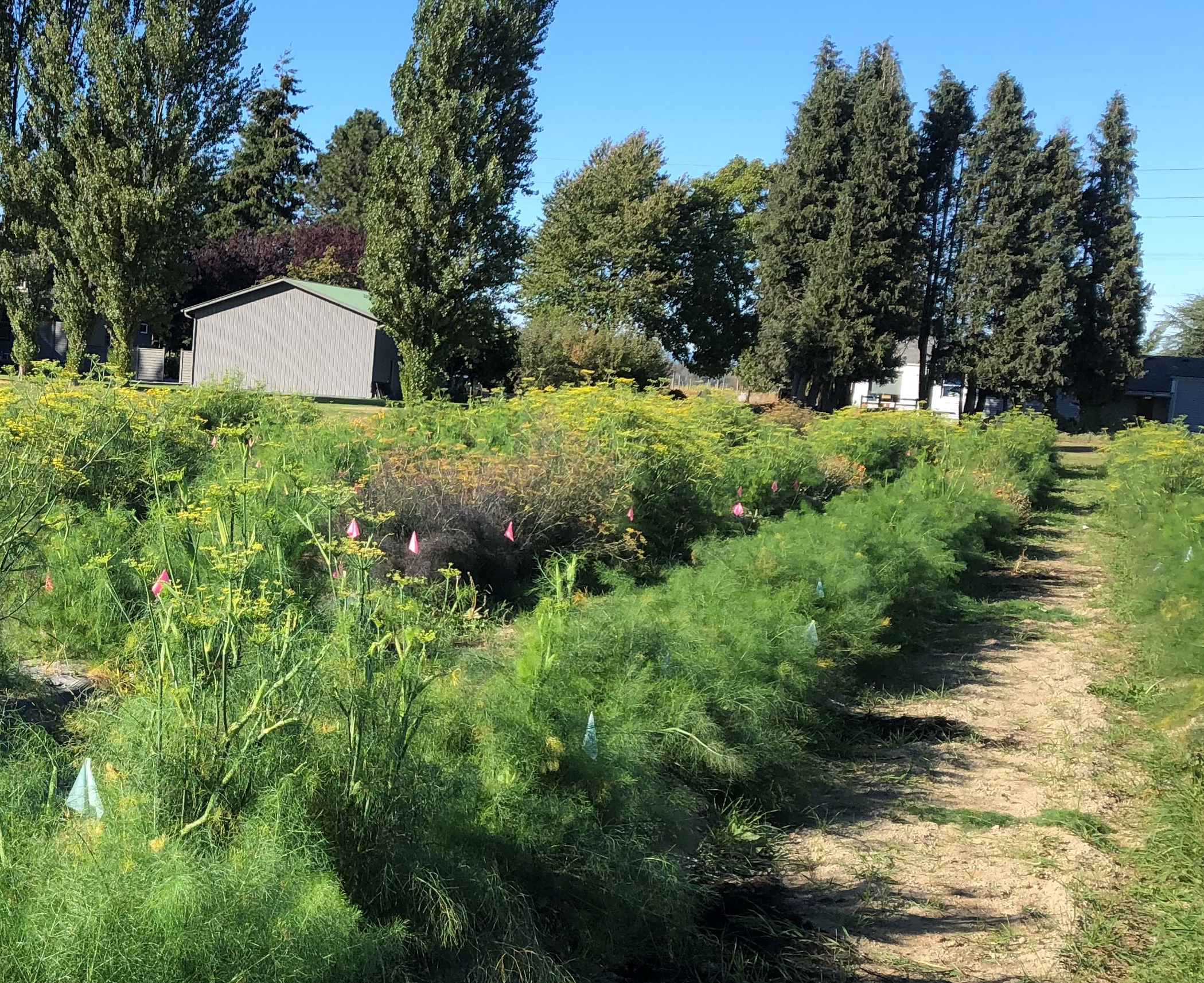
Growing Bulb Fennel in the Pacific Northwest
A Grower’s Guide to Bulb Fennel
Authors: Carol A. Miles, Thomas S. Collins, Yao Mu, and Travis Robert Alexander
Affiliation: Washinton State University
Bulb fennel (Foeniculum vulgare) is well suited for production in the maritime Pacific Northwest based on its summer climate. This guide provides information on planting, growing, and harvesting bulb fennel.
Introduction
Bulb fennel is in the Apiaceae family along with carrots, celery, and parsley. The base of the leaf stem swells to form the crisp bulb-like structure that is harvested as a vegetable. Bulb fennel is eaten raw, sauteed, stewed, or roasted, and the leaves can be used as a subtly-licorice flavored herb. As a traditional part of the Mediterranean diet, bulb fennel is associated with positive health impacts, including prevention of cardiovascular diseases, cancer, and inflammation (Bower et al., 2016).
Bulb fennel grows well in the long summer days and mild, maritime climate of western Washington, where the climate is similar to the Sicilian environment where it is traditionally produced. Bulb fennel is a good rotational crop for Western Washington as it is in a different family than common regional crops like potato (Solanum tuberosum), cabbage (Brassica oleracea), and spinach (Spinacia oleracea). In the Pacific Northwest, bulb fennel has few insect pests and diseases, and its moderately low nutritional requirements for growth solidify it as an excellent addition to western Washington farms.
Planting
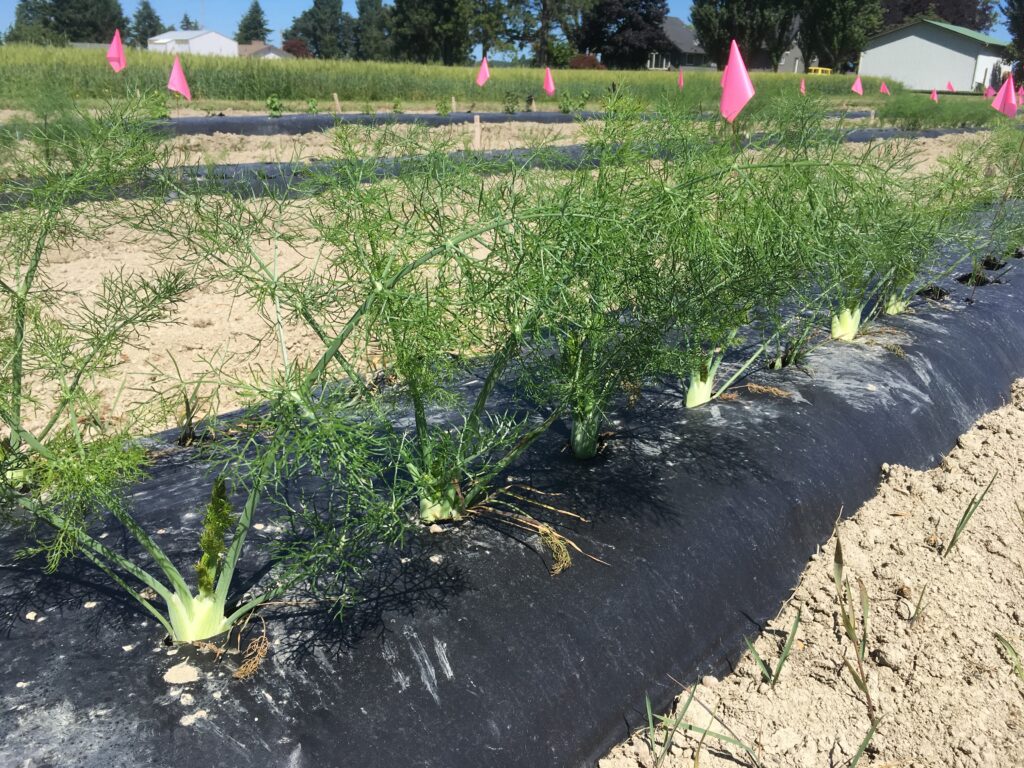
Bulb fennel can be directly seeded in the field or transplanted as seedlings started in a greenhouse (Miles et al. 2019). There are a few considerations when determining which method to use.
Direct seeding can provide a shorter seed-to-harvest time which can be beneficial for bulb tenderness especially if planting later in the season. Transplanting removes many variables that can negatively impact seed germination and early establishment, such as weather fluctuations, pests, weeds, etc. However, this method is more labor and resource intensive and requires suitable greenhouse space. For both planting methods, seeding date can impact the quality of fennel bulbs, with earlier-seeded plants producing more tender bulbs than plants seeded later.
Planting Directions:
Direct seeding: Plant two seeds in each planting hole, at 1/4 to 1/2 inch depth. After 4 weeks, if two seedlings emerge, remove the weaker seedling.
Transplanting: Plant seeds in plastic cell trays (e.g. 72-cells) with one seed per cell. Maintain greenhouse conditions of 75 to 80 oF and 80% humidity. After 4 weeks or when the first 2–3 true leaves emerge, move seedlings outside to harden for 3 days before transplanting to the field.
Plant bulb fennel in a double row on a raised bed that is 2–3ft wide. For weed control, cover beds with black plastic mulch. Space the rows 12 inches apart on the bed, and space the plants 8 inches apart within the row.
Apply 100 lb N/acre to the soil before bed shaping. Apply supplemental fertilizer (e.g. 2.1 lb N/acre) via the drip irrigation system three times throughout the fennel growing season to improve plant productivity and bulb size. Ensure the supplemental fertilizer product is labeled for fertigation before applying.
See Table 1 for varieties that have been tested in Mount Vernon, WA. Bulb fennel thrives in the long, warm days of early summer in western Washington. The decrease in daylength following the summer solstice (late June) signals the fennel plants to form its bulb. Earlier seeding leads to larger and more tender bulbs. Varieties that bolt (form flower stalks) in the long daylength of summer in this region should not be planted. Note that drought stress can cause bulb fennel to bolt, so ensure plants are irrigated each week.
Field Maintenance
Use drip irrigation to grow bulb fennel as it conserves water and keeps the canopy dry, which helps reduce disease incidence. Install drip tape with 8-inch emitter spacing (e.g., T-Tape model 508-08-340; Rivulis Irrigation, San Diego, CA) between the two rows. If using plastic mulch, place the drip tape on the center of the beds under the mulch as the beds are formed. After seeding or transplanting, irrigate three times per week for approximately 75 min each irrigation, and reduce application with precipitation. After 2-3 weeks or whenever plants are established, reduce irrigation to once per week.
Weed management can be challenging early in the season as bulb fennel is difficult to weed by hand due to its small, slow-growing seedlings, similar to carrots. Plastic mulch laid over the bed helps minimize weeds, and hand-weed planting holes as needed.
Harvesting
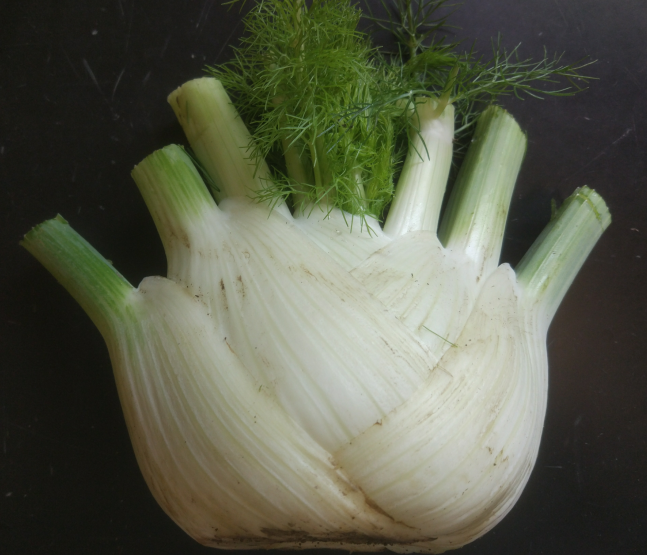
On average, fennel bulbs take 105-115 days to reach full maturity in northwest Washington. Seed-to-harvest date can vary between cultivars and differing growing conditions. Harvest bulb fennel when the bulbs are rounded in shape and at least 4 inches in width, being mindful that bulb size can vary by variety and growing conditions. Harvest bulbs as soon as they reach a good size, as over maturity leads to less-tender bulbs. The table below presents average bulb circumference and yield for 12 cultivars grown in Mount Vernon, WA (Miles et al. 2019).
Table 1. Bulb varieties that have been tested in Mount Vernon, WA. Varieties with low yield are not suitable for production in northwest Washington.
| Cultivar | Bulb Circumference (in)¹ | Yield (lb/acre)² | Yield (lb/100ft double row) |
|---|---|---|---|
| Finale | 13.3 | 14,917 | 171 |
| Florence | 8.6 | 2,571 | 30 |
| Genesi | 10.9 | 9,645 | 111 |
| Idillio | 10.7 | 7,053 | 81 |
| Orazio | 12.2 | 16,825 | 193 |
| Orion | 10.8 | 13,248 | 152 |
| Perfection | 10.2 | 10,860 | 125 |
| Preludio | 12.0 | 14,246 | 164 |
| Solaris | 11.7 | 14,176 | 163 |
| Tauro | 11.5 | 16,947 | 195 |
| Tenance | 11.3 | 14,168 | 163 |
| Zefa Fino | 9.3 | 3,138 | 36 |
²Yield averaged from two years of harvest in Mount Vernon, WA (2017 and 2018). Yield was calculated by multiplying the estimated production potential constant of 48,214 (the maximum number of bulbs per acre when spacing is 8 inches in-row, two rows per bed, and 5 ft between beds) by the average bulb weight.
³Yield per 100 ft calculated first by determining total row footage [1 acre (43560 ft2)/5 ft between beds = 8712 row ft]. Next, determine the number of 100-ft rows [8712 row ft/100 ft beds = 87.12 100-ft rows]. Divide acre yield by 87.12 for yield per 100 ft bed.
References
Bower, A., S. Marquez, and E.G. de Mejia. 2016. The health benefits of selected culinary herbs and spices found in the traditional Mediterranean diet. Crit. Rev. Food Sci. Nutr. 56:2728–2746
Miles C, Collins T, Mu Y, Alexander T. 2019. Identifying bulb fennel cultivars suitable for production in the northwest United States. . Hortechnology. https://doi.org/10.21273/HORTTECH04372-19.