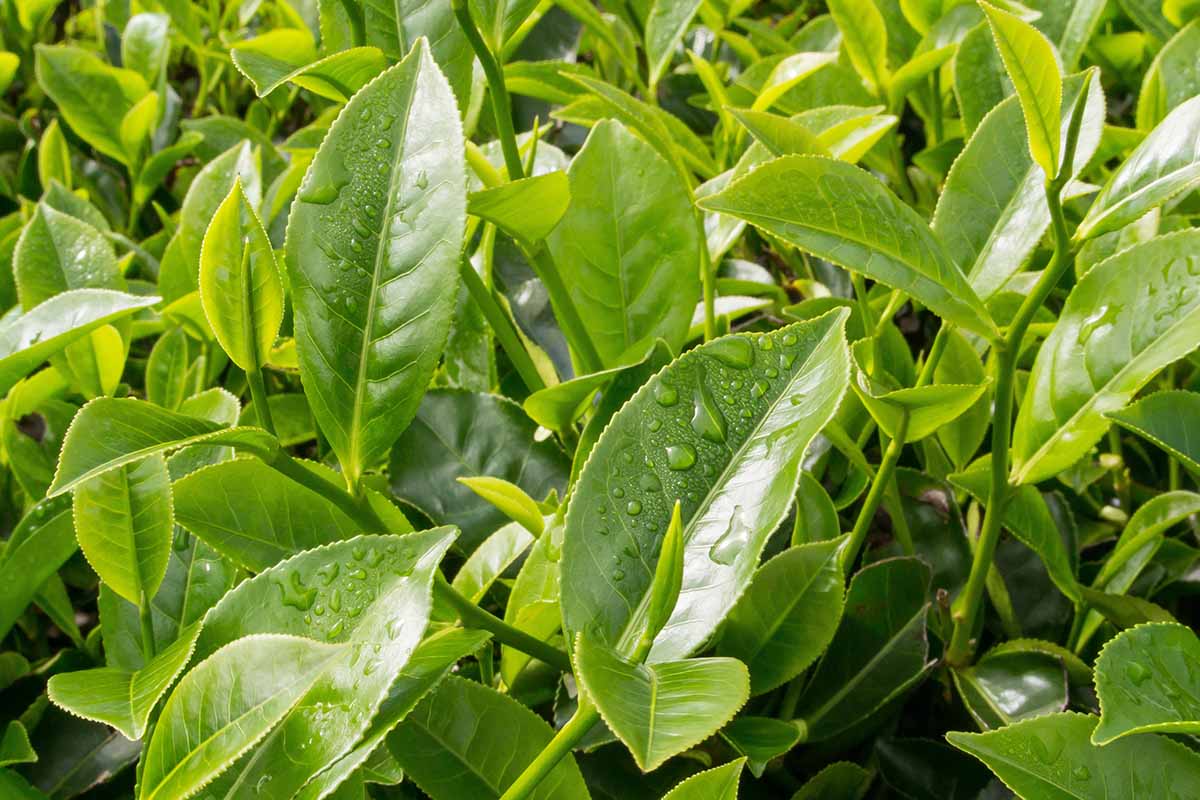
Growing Tea in the Pacific Northwest
Starting Tea from Seed
Authors: McKenzie Shelton, Jessica Weaver, Carol Miles
Affiliation: Washington State University, Northwestern Washington Research and Extension Center, Mount Vernon
All types of tea made with leaves of the tea plant (Camellia sinensis) can be made from the leaves of the same plant. It is the processing method that determines the type of tea that is made, not the tea plant cultivar. Different tea cultivars do have nuanced differences in flavors, and different regions of the world are known for producing a certain type of tea. This guide provides a summary of how to grow tea from seed.
Introduction
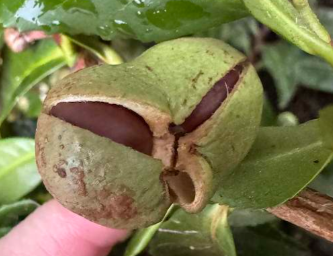
Tea produces seeds once a year in Fall and early Winter. Seed pods are three-lobed capsules that take upwards of 1 year to develop. Tea plants flower in the Fall and Winter and seeds are matured by the same time next year. Seeds can be collected around November or December in northwest Washington. Collect the seeds when the shells are brown and starting to split. The seeds are genetically variable from the mother plant and each other, each seed will grow into a genetically individual plant.
Collecting Seeds
We collected seeds on 24th October 2024 in Burlington, WA. Mother plants were at least 4 years old. Collected seed pods directly from the plant and tracked the mother line. Seeds from the ground were not collected. At this point, the majority of the seeds were slightly immature.
Propagation
We mixed potting media of peatmoss, vermiculite, and perlite (5:3:2 ratio, vol) in a shallow plastic tray. The initial pH measured 4.7 and was around 5.2 after a year. Seeds were placed in the potting media while still in their shells the same day they were collected. The tray was covered with a clear plastic dome to raise the humidity but was slightly offset to allow for some airflow. The greenhouse temperature was set to 70–75 °F. Trays were hand-watered [how often?] to keep the potting media moist. Seeds typically take 4–8 weeks to germinate if planted with shells on. The shells were removed from the seeds around 20th Nov 2024. Seeds then sprouted around 9th Dec 2024. By 14th Jan 2025 lots of the seedlings had sprouted.
Repotting and Mist Chamber
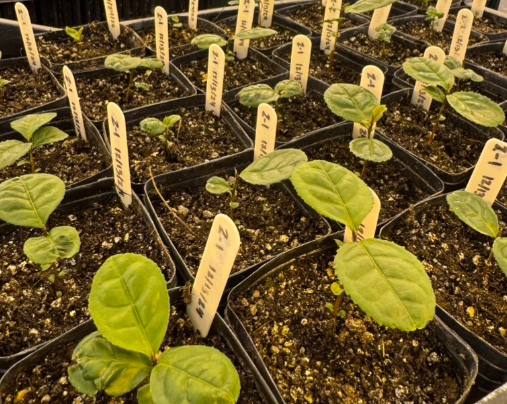
The sprouted seedlings were planted in treepots (7.5 cm x 7.5 cm x 20 cm) and placed in mist chambers soon after emergence to accommodate taproot production. The mist chamber was kept around 75 °F with a relative humidity of 60–70% and misting was set to 30 sec for every 1 hour. The treepots were placed on seedling heat mats set to 80–90 °F.
Fertilizer
Liquid fertilizer was first applied around 7th May 2025. Concentrate 1350 g/5 gal, mixed in a 1:100 ratio with water. 200 mL per pot or until soaked through. First Osmocote application (1/2 tsp per plant) was 4th June 2025. Late June was the second application.
Moving on from Mist Chamber
In late May the layers of plastic and row cover were pulled back and the heat mats were turned off. The plants were moved to the hoophouse on the 29th of August 2025. Plants were moved back into the greenhouse for the winter on 26th September 2025.
This work is supported by the Washington State University Emerging Research Initiative program, the National Institute of Food and Agriculture, U.S. Department of Agriculture Western Sustainable Agriculture Research and Education program (project number G123 -25-WA509), Hatch Project 7005372, Washington State Department of Agriculture Nursery Grant, and the Northwest Agriculture Research Foundation. Any opinions, findings, conclusions, or recommendations are those of the author(s) and do not necessarily reflect the view of the U.S. Department of Agriculture.
Product information is provided as examples in this publication and is not intended to endorse these products. Similar products that function the same can be used.