Growing Tea In
The Pacific Northwest
Planting and Establishment
Authors: Srijana Shrestha1, McKenzie Shelton2, Chakradhar Mattupalli2, and Carol Miles2
Affiliations: Oregon State University1, Washington State University2
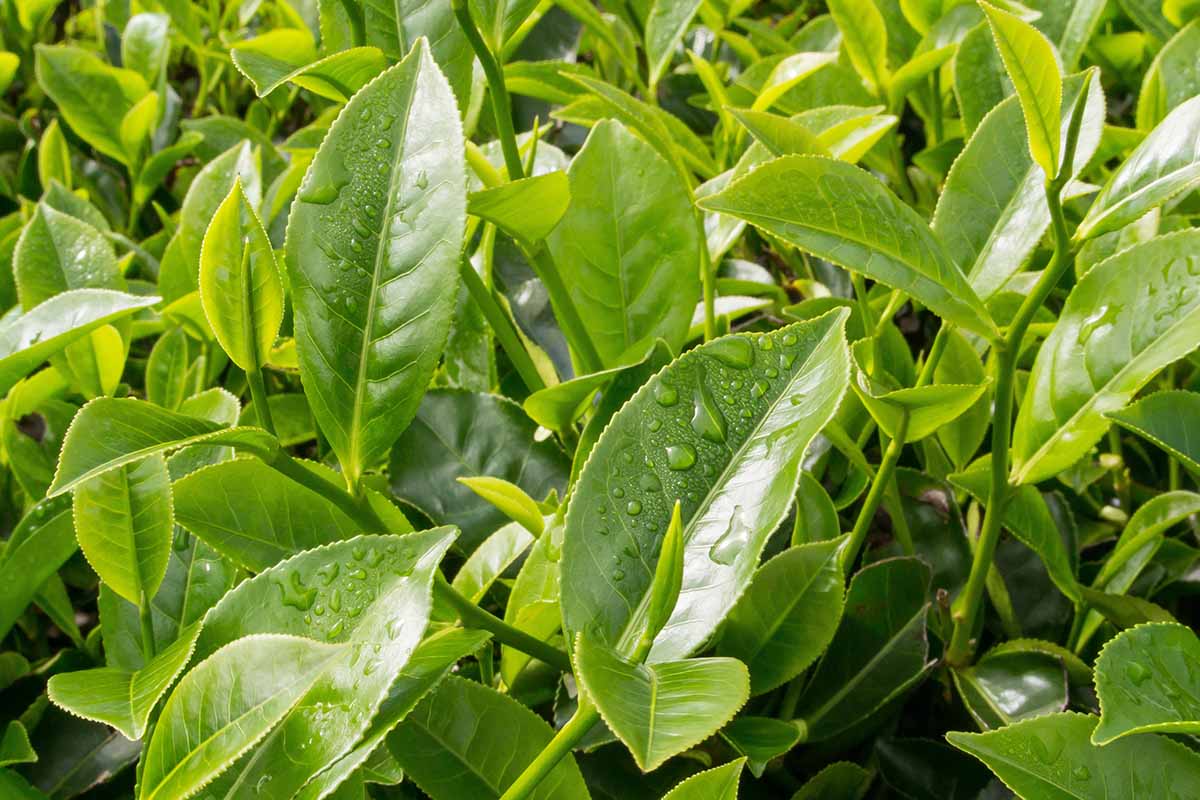
Tea plants (Camellia sinensis) can be grown in the Pacific Northwest. This guide provides an overview of how to plant and care for your tea plants in the first year.
Introduction
Tea made from leaves of Camellia sinensis (the tea plant) is the second most popular beverage in the world. The consumption of tea is increasing in the United States with increased awareness of the health benefits of tea and consumer interest in locally sourced and home-grown tea, as well as specialty tea beverages. The Pacific Northwest has a favorable temperate climate with adequate rainfall and acidic soils that make it well-suited for growing tea. This series of tea production guides will help home gardeners and small-scale growers establish and care for tea plants as well as make a finished tea product.
Site Selection and Preparation
Similar to blueberry, tea plants prefer well-drained, acidic soils with pH ranging from 4.5 to 5.5. Blueberry field preparation recommendations for the Pacific Northwest can be followed for tea planting. Soil pH above 5.5 negatively affects tea plant growth and produces untimely flowering. If the soil pH needs to be lowered, apply ammonium-based acidifying fertilizers or elemental sulfur. There are specially formulated acidifying fertilizers for acid loving plants such as camellias, azaleas, and rhododendrons that can be used for tea; follow their label for application directions. Under these acidic conditions, mycorrhizal associations in the soil can increase root development and leaf nutrient content of tea. You can apply a thick layer (up to 6 inches) of bark or wood chips to help maintain a low soil pH.
If your location is very sunny and hot, shade may be needed for Assam-type tea plants, which may be more susceptible to high temperature stress due to their flatter leaf angle.
Excessive wind adversely affects tea plants. Windbreaks help to prevent high evapotranspiration, water stress, and cold damage.
Planting Time
Plant tea in the spring after the risk of frost has passed or early fall so that the plants become adapted before the winter. In the Pacific Northwest region, spring planting is preferred to avoid winter damage to new plantings.
Planting
Tea plants should have a well-developed root system and a primary shoot about 8 inches tall before planting. At WSU Mount Vernon NWREC, tea plants rooted from cuttings achieve this growth in 12 to 18 months. Tea can be planted using either the hole or trench method, or in containers.
Hole Method
Dig a hole about 18 inches deep and 18 inches wide. Place about 1 oz (6 teaspoons) of superphosphate fertilizer in the bottom of the hole and cover with at least 2 inches of compost mixed with the soil that was removed from the hole. Set the plant in the hole so that the soil surface is aligned with the soil line of the potted tea plant. Fill the hole with the compost and soil mixture. Tap the sides down firmly.
Trench Method
Use a tractor to create a trench 18 inches wide and 18 inches deep. A subsoiler may be required to break up dense under-layers to improve rooting conditions. Mix compost into the soil that was moved by trenching. Place about 1 oz (6 teaspoons) of superphosphate fertilizer into the bottom of the trench where each plant will be placed. Alternatively, for a 100-foot row with 50 tea plants spaced 2 feet apart, evenly distribute 3 ¼ pounds (6 ¼ cups) of fertilizer throughout the length of the trench. Cover the fertilizer with 2 inches of the soil-compost mixture. Place the plant over this fertilizer-soil-compost and fill in the trench with the remainder of the soil-compost, tapping down so plants are firmly in place.
Container Planting
Use a deep large-sized container (>5 gallons) to allow more space for growth, especially for the root system. Apply slow-release fertilizers (e.g. Osmocote Plus) as directed on the label at the time of planting. If the temperature falls below freezing in the winter, place the container inside or wrap the pot with insulating material to prevent the root system from freezing.
Spacing
If you are planting a single tea plant, leave 6 feet between the tea plant and other plants or structures. If you are forming a tea hedge, space plants about 2 to 4 feet apart in a row. Tea plants can grow to the size of a small tree (Assam-type tea plants can reach 30–50 feet in height, and China-type can reach 15–25 feet in height), but when cultivated for tea, plants are pruned to waist height to facilitate leaf picking.
Establishment
Tea plants tend to form a shallow root system (about 16 inches deep) with many adventitious roots. Growing tea plants in the shade can decrease root growth, and pruning young leaves can also reduce root growth. Do not prune plants or pluck leaves between October and February to ensure plants overwinter successfully, and the root system grows more vigorously. It usually takes 3–4 years for tea plants to be ready for first harvest, though they will not be considered “mature” until closer to 10 years old. In tropical areas such as Hawaii, many cultivars are ready for harvest 18–20 months after planting.
Irrigation
If there is insufficient rainfall, water 2–3 times per week during the establishment stage to help build the root system. Tea plants may become established within 6 months of planting. Do not let the plants dry out or become waterlogged. You can also apply a thick layer (up to 6 inches) of bark, wood chips, or other mulch material to conserve soil moisture.
References and Further Reading
- Brun C, DeVetter L, Benedict C. 2016. Growing Small Fruits in the Home Garden. Washington State University Extension. EM103E. https://pubs.extension.wsu.edu/product/growing-small-fruits-in-the-home-garden-home-garden-series/
- Lukas S. 2014. Growing blueberries in your home garden. Extension Communications. https://extension.oregonstate.edu/catalog/pub/ec-1304-growing-blueberries-your-home-garden
- Tipton TV, Yokoyama KM, Wanitprapha K, Nakamoto ST.1990. Tea (pdf). University of Hawaii Economic Fact Sheet No. 8. https://www.ctahr.hawaii.edu/oc/freepubs/pdf/EFS-8.pdf
- Zee F, Sato D, Keith L, Follett P, Hamasaki RT. 2003. Small-scale tea growing and processing in Hawaii (pdf). University of Hawaii-Manoa Cooperative Extension Service NPH-9. https://www.ctahr.hawaii.edu/oc/freepubs/pdf/nph-9.pdf




This material is based upon work that is supported by Washington State Department of Agriculture Nursery Grant. Any opinions, findings, conclusions, or recommendations expressed in this publication are those of the author(s) and do not necessarily reflect the view of the Washington State Department of Agriculture. Product information is provided as examples in this publication and is not intended to endorse these products. Similar products that function the same can be used.