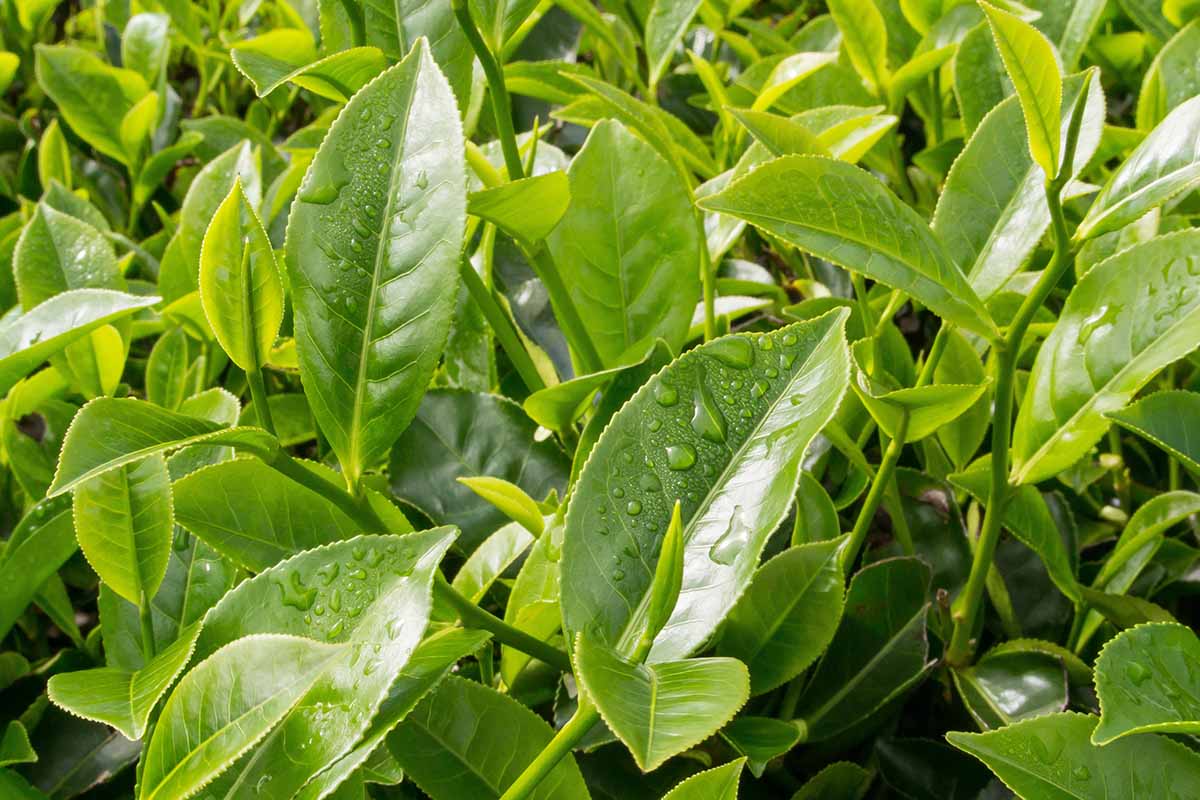
Growing Tea in the Pacific Northwest
Tea Types and Home Processing
Authors: McKenzie Shelton1, Srijana Shrestha2, Jessica Weaver1, Carol Miles1
Affiliation: Washington State University, 1Northwestern Washington Research and Extension Center, Mount Vernon; 2Oregon State University Extension
All types of tea made with leaves of the tea plant (Camellia sinensis) can be made from the leaves of the same plant. It is the processing method that determines the type of tea that is made, not the tea plant cultivar. Different tea cultivars do have nuanced differences in flavors, and different regions of the world are known for producing a certain type of tea. This guide provides a summary of the different processes used to make the most common types of tea. Also included are step-by-step guides that can be followed at home to make each type of tea and the results of a tea taste test conducted at WSU NWREC in Mount Vernon, WA.
Tea Processing
All tea made from Camellia sinensis starts by harvesting fresh, young leaves. The top 2, 3, or up to 5 leaves (including the emerging top leaf) can be harvested. The steps for making tea at home can differ from how tea is made commercially. The key is to know what type of tea you would like to make and the processes that are needed to achieve this type. Here is a summary of the key processes that are used to make tea.
Withering
Harvested leaves are first withered to remove some moisture. Harvested fresh leaves are spread out in a thin layer on a screen or bamboo tray and hot air is blown from the bottom to evaporate the moisture. Leaf moisture is reduced to about 70%. Without withering, the later steps can result in cooked leaves instead of the desired dried leaves. At home, tea leaves can first be dried slightly before moving to the next step.
Bruising
Tea leaves are physically handled to break down their cell walls to release cell contents and expose enzymes to the air. This process transforms the leaves’ flavor, aroma, and color.
Rolling
Tea leaves are rolled by hand or using a rolling machine. This causes the tea leaf to wrap around itself and release cell contents including essential oils to the leaf surface. This enhances the strength and taste of the tea. Rolling can occur as a form of bruising to initiate oxidation, or after fixation to enhance the aroma and flavor and is also called shaping.
Oxidized
Tea leaf surface is broken (often by bruising), releasing cell contents to the leaf surface where they are exposed to the air, which causes the leaf to darken when dried with warm temperature. This contributes to the flavor, aroma, and strength of different teas. The term “fermented” is used interchangeably with oxidation when describing processing tea leaves.
Fixation
Quickly heating the oxidized leaves, either by steaming (Japanese method) or heating in a pan/wok (Chinese method) to halt the oxidation process and preserve green color.
Processing Steps
Withering tea leaves is often the first step for making most tea types. Leaves for green tea may be briefly withered, but is not required. Kneading the leaves causes bruising, which initiates the oxidation process. Rolling and shaping intensify the oxidation process. Oxidation transforms the flavor, aroma, and color of the leaves, causing the dry leaf to be darker. Tea leaves are fixed by heating, which stops the oxidation process and darkening of the leaves. Leaves are then dried, which can be in the sun, indoors, or in a food dehydrator. Drying is the final step that removes residual moisture from the leaves making it suitable for storage.
Types of Tea
Here are the main types of tea and some simple processing steps that can be followed at home to make each type. Note there are other teas in addition to the ones listed here, and there are many options for making each type of tea. We are providing the steps we have followed at home and found to be successful.
White Tea
Non-oxidized tea simply made by drying the leaves. The least processed tea. Traditionally, the plants are shaded to prevent sun exposure and reduce chlorophyll content, leading to a pale leaf color. Non-shaded leaves can also be used to make this light flavored tea.
Steps:
Harvest top 3 leaves. Dry leaves in the sun or indoors (Fig. 1 & 2). Do not touch leaves during drying.
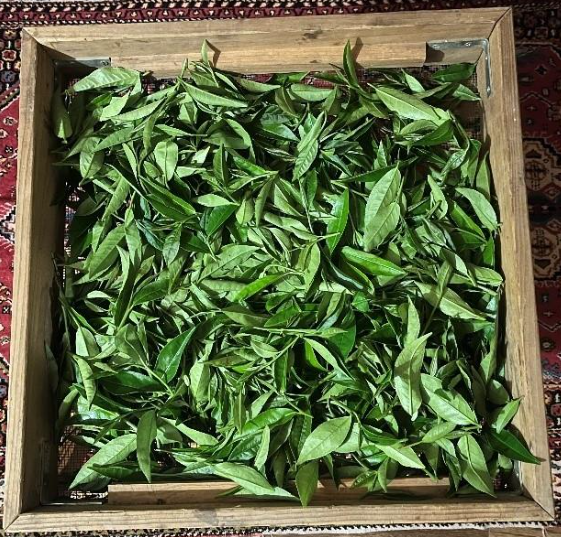
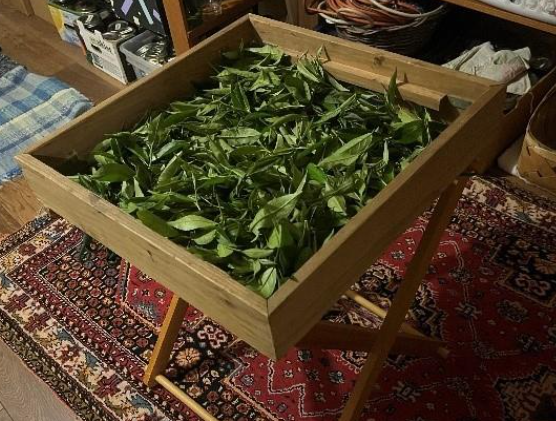
Figure 1. Tea leaves spread out on a screen for drying (left), and screen on a rack, drying indoors (right).
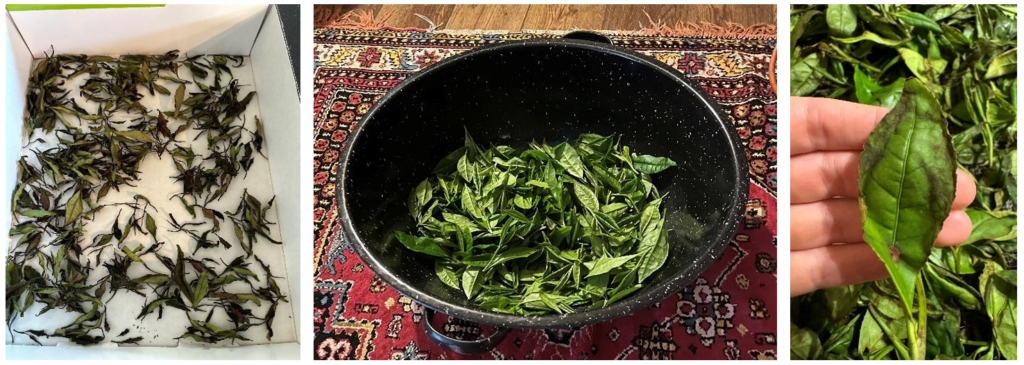
Figure 2. Drying tea leaves inside the house in a box placed in a sunny spot (left) and in a large metal bowl in a dark room (right), and a leaf that is 30% brown and 70% green.
Red Tea
Oxidized, dark-colored dried leaves that produce a crimson-colored brewed tea. A smooth flavor profile with floral notes.
Steps:
Harvest top 3 leaves. Dry leaves in a large metal bowl in a dark room (Fig 2). Turn leaves and knead or shape to cause bruising, two times per day for 4 days or until dry (Fig. 3).
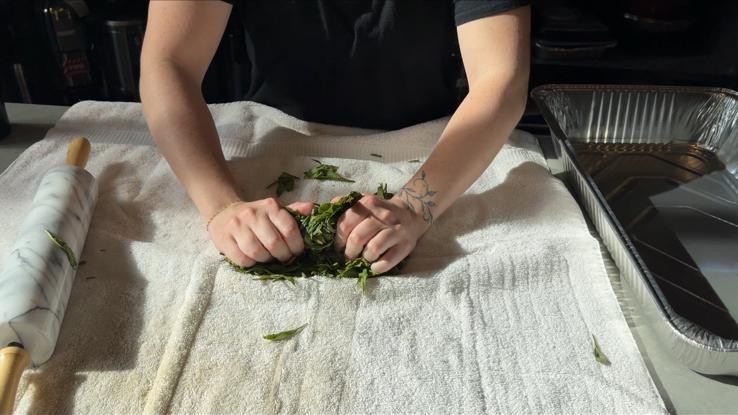
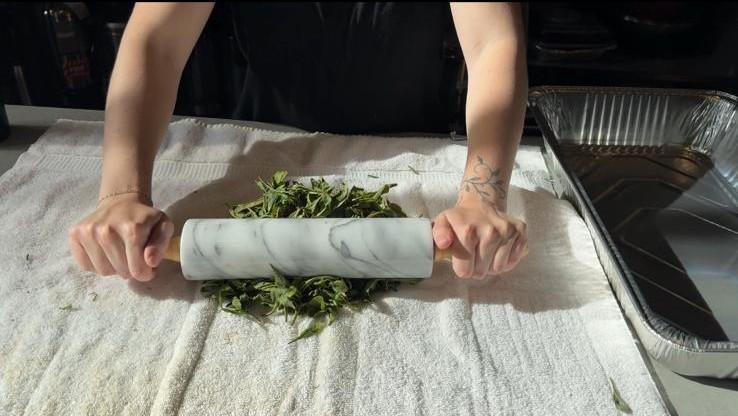
Figure 3. Shaping or kneading (left), and rolling (right) tea leaves; the towel absorbs moisture, which aids in drying the leaves.
Green Tea
Tea with green color, with very little to no oxidation as the leaves are heat-treated very early in processing. Leaves are then rolled and often further heat-treated before drying. The main active constituent is epigallocatechin gallate (EGCG), commonly called catechin.
Steps:
Harvest top 3 leaves. Pan-fry or wrap leaves in a towel and microwave for 1 to 2 min (Fig. 4). Spread leaves to cool. Roll leaves for 2 to 5 min, then (optional) pan fry leaves for 1 to 2 min. Leaves can be oven-dried at ~200 °F for 2 to 3 hr then air dried or simply air dried as long as needed.
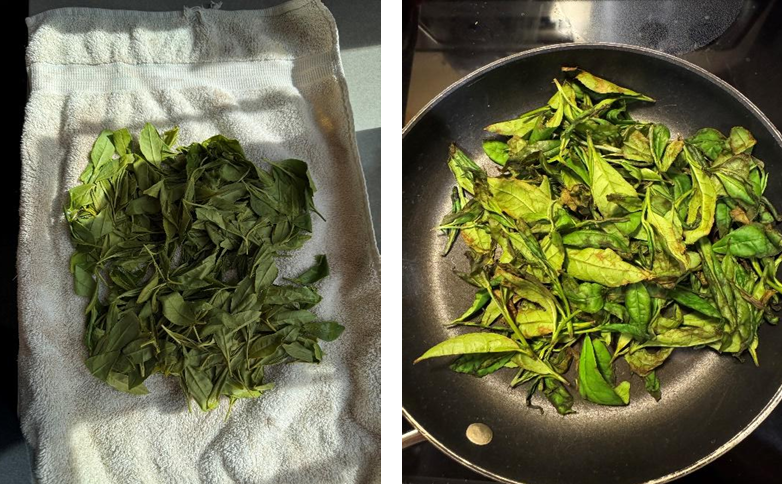
Figure 4. Tea leaves on a towel that is folded over the leaves and then placed in the microwave for 1 to 2 minutes for steaming (left), and pan fried on the stove (right).
Oolong Tea
Partially oxidized tea requiring more processing than green tea, but less than black tea. Oolong flavor is often floral and complex, while not being as “strong” as black tea. After the desired amount of oxidation is reached, leaves are heat treated at high temperature to prevent further oxidation.
Steps:
Harvest top 3 leaves. Spread leaves outside on a screen in direct sunlight for 15 min, then rest indoors for 1 hr. Hand-toss leaves for 2 min and rest for 1 hr; repeat 3 times or until leaves are generally 30% brown, 70% green (Fig. 2). Pan-fry leaves on medium heat for 3 to 4 min. Hand-roll leaves for 15 min and then air-dry for 3 days or as long as needed.
Black Tea
Most extensively oxidized tea. Leaves are bruised throughout the drying process, with no heat treatment as it would slow oxidation. Rolling is often used to induce oxidation. Black tea constitutes 80% of the total world tea market.
Steps:
Harvest top 2 to 5 leaves. Wrap leaves in cheesecloth and hand-roll for 2 min. Air-dry leaves for 3 days, with hand mixing and vigorously tossing 2 times per day.
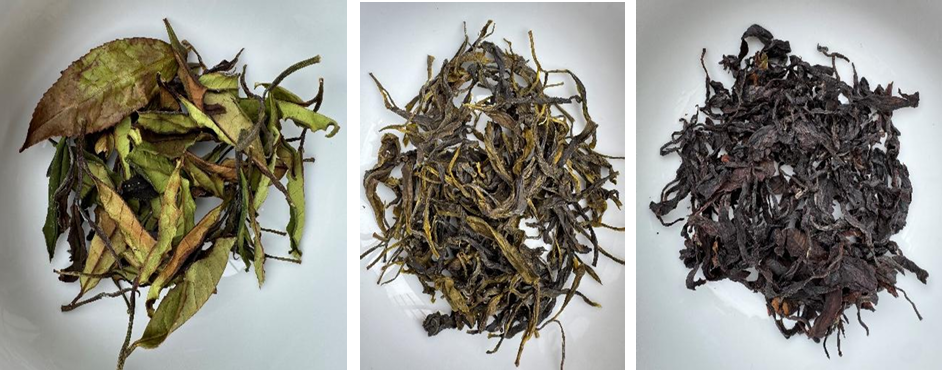
Figure 5. White tea (left), green tea (center) and black tea (right), each made following home processing steps.
Tea Taste Test
A tea tasting was conducted at WSU Mount Vernon NWREC on 23 July 2025 with 31 participants tasting 8 teas. All the teas were harvested from the same 28-year-old tea (Camelia sinensis) plants, cv. Minto Pacific, grown in Burlington, WA. Each tea was processed at home, following different methods. This is a test of simple tea leaf drying and processing techniques that do not require special equipment or supplies. This supports our goal of developing home-grown tea as part of our WSDA Nursery Industry project.
Teas in the tasting were arranged from lightest to strongest flavor, to maintain flavor differentiation as much as possible. All the teas were brewed following the same method: 18 g of tea leaves were placed in a glass pot, and 1.4 L (6 cups) of hot (180 F) water were added. The tea was steeped for approximately 10 minutes, then poured into white paper cups so that color of the tea was visible.
The tea tasting score sheet was assembled based on several tea taste evaluation sources, and we tested it in our program the day before. Survey questions included ratings from 1–5 regarding color of the tea (light to dark), aroma strength (weak to strong), aroma quality (muted to complex), strength of taste (light to full-bodied), bitterness (low to high), dryness (not dry to very dry), aftertaste length (short to lingering), characters (sweet, crisp, vegetal, etc.), and overall quality (undesirable to excellent).
The Oolong tea and the first black tea using the top 4 to 5 leaves were crowd favorites.
| Tea Name | Procedure | Overall Rating | Aroma Rating | Aroma Description |
|---|---|---|---|---|
| White Tea | Top 3 leaves harvested Leaves screen-dried indoors in ambient light (no direct sunlight) Leaves not touched after placed on screen | 3.1/5 | 2.8/5 | Vegetal, Earthy |
| Red Tea | Top 3 leaves harvested Leaves dried in large metal bowl in dark room Leaves vigorously turned and rubbed 2x per day for 4 days | 3/5 | 2.7/5 | Floral, Earthy |
| Green Tea | Top 3 leaves harvested Leaves wrapped in towel and microwaved for 1 min Leaves spread to cool Leaves rolled with a heavy rolling pin for 5 min Air-dried for 3 days | 1.9/5 | 1.9/5 | Acidic, Vegetal |
| Green Tea | Top 3 leaves harvested Leaves pan-fried for 1–2 min Oven-dried at ~200 °F for 2–3 hr Air-dried for 1-2 days | 2.8/5 | 2/5 | Earthy, Vegetal, Floral |
| Green Tea | Top 3 leaves harvested Leaves microwaved in a towel for 2 min, and spread to cool Leaves rolled for 1–2 min, then spread Leaves pan-fried on low heat for 1–2 min Leaves rolled for 1–2 min and pan-fried on low heat for 5–6 min twice Leaves air-dried for 3 days | 2.7/5 | 2.6/5 | Earthy, Vegetal |
| Oolong Tea | Top 3 leaves harvested Leaves spread outside on screen in direct sunlight for 15 min, then rested indoors for 1 hr Leaves hand-tossed for 2 min and rested 1 hr twice Leaves pan-fried on medium heat for 3–4 min Leaves hand-rolled for 15 min and air-dried for 3 days | 3.8/5 | 3.6/5 | Floral, Earthy, Sweet |
| Black Tea | Top 4–5 leaves harvested Leaves wrapped in cheesecloth and hand-rolled for 2 min Leaves air-dried for 3 days, with hand mixing and tossing 2x per day | 3.8/5 | 3.1/5 | Floral, Earthy, Sweet |
| Black Tea | Top 2 leaves harvested Leaves wrapped in cheesecloth and hand-rolled for 2 min Leaves air-dried for 3 days, with hand mixing and tossing 2x per day | 3.7/5 | 3.2/5 | Sweet, Floral |
This work is supported by the Washington State University Emerging Research Initiative program, the National Institute of Food and Agriculture, U.S. Department of Agriculture Western Sustainable Agriculture Research and Education program (project number G123 -25-WA509), Hatch Project 7005372, Washington State Department of Agriculture Nursery Grant, and the Northwest Agriculture Research Foundation. Any opinions, findings, conclusions, or recommendations are those of the author(s) and do not necessarily reflect the view of the U.S. Department of Agriculture.
Product information is provided as examples in this publication and is not intended to endorse these products. Similar products that function the same can be used.