Growing Tea In
The Pacific Northwest
Care and Maintenance
Authors: Srijana Shrestha1, McKenzie Shelton2, Chakradhar Mattupalli2, and Carol Miles2
Affiliations: Oregon State University1, Washington State University2
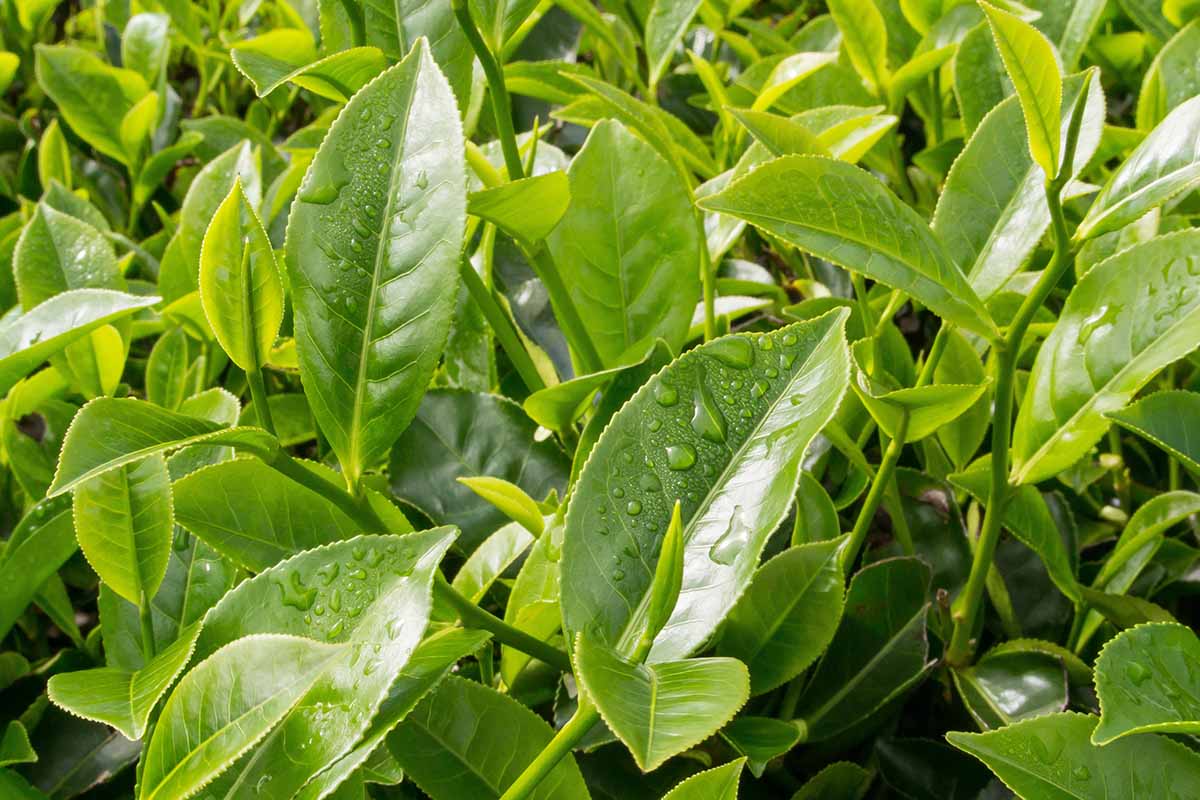
Tea (Camellia sinensis) can be grown in the Pacific Northwest. This guide provides general tea plant care and maintenance recommendations for commercial nurseries, small-scale farmers, and home gardeners in western Washington or similar climatic regions.
Introduction
Tea made from the leaves of Camellia sinensis (the tea plant) is the second most popular beverage in the world. The consumption of tea is increasing in the United States with increased awareness of the health benefits of tea and consumer interest in locally sourced and home-grown tea, as well as specialty tea beverages. The Pacific Northwest has a favorable temperate climate with adequate rainfall and acidic soils that make it well-suited for growing tea. This series of tea production guides will help home gardeners, nurseries and small-scale growers propagate, establish and care for tea plants as well as make a finished tea product.
Irrigation
Once tea plants are established, about 6 months after transplanting in the field or garden, apply about 1 inch of water every 7 to 10 days June through October, depending on weather and soil conditions. This amount of irrigation can be achieved using a soaker hose with faucet open about quarter-strength or irrigating about 5 hours a week using a drip tape. Check plants to make sure they are receiving enough water and adjust irrigation timing as needed. Relative humidity should not be less than 40%, and sprinkler irrigation can be used to increase relative humidity up to 80%, which is desirable for tea plants, as they do not tolerate hot and dry conditions.
Potted tea plants should be watered as frequently as needed during the summer, so the soil does not completely dry out. If the weather is hot and dry, this could be every day. If the weather is cooler and/or overcast, this could be 1 to 3 times per week.
Fertilizer
Apply slow-release fertilizer (e.g., Osmocote® Smart-Release® Plant Food Plus Outdoor and Indoor, The Scotts Company, Marysville, OH; https://osmocotegarden.com/products/outdoor-indoor-plus/) to the base of the plant (1 teaspoon per plant) in both mid-spring and late summer. For the first 3-4 years, when the plant is becoming established, two fertilizer applications per year should be adequate. If leaf color is light green, an indicator of nitrogen stress, apply fertilizer a third time, in mid-summer. Once tea leaf harvest begins, when the plant is 4-5 years old, apply slow-release fertilizer at the rate of 1 teaspoon per plant once a month from late spring through late summer.
For field plants, mix and apply a soluble fertilizer that will maintain an acidic soil pH between 4.5 and 5.5. An example is Grow More 30-10-10 All Purpose Plant Food (GrowMore, Gardena, CA; https://www.growmore.com/fertilizers). The fertilizer can be mixed with water (read the fertilizer label for appropriate mixing ratio) and applied manually to each plant. For larger plantings, apply the fertilizer through the irrigation system (fertigation). If fertilizer is being applied via fertigation through drip tape or drip tube emitters, consult the fertilizer product label to verify it can be applied in this manner. For younger tea plants that have been in the field for 3 years or less, apply an annual total target of 100 lb/A. For plants 4 years or older, and especially those in full production, apply a total of 120–160 lb/A. In all years, split the fertilizer into 2–4 applications from late spring through late summer. Do not apply fertilizer in the fall or winter, as this can promote new growth that is susceptible to cold damage.
Pruning
Tea plants naturally grow as a tree with a main leader stem, and if not pruned, the plants can grow 20 to 40 feet tall. Pruning young tea plants is essential to create a flat top that is waist- or chest-height (about 4 ft), referred to as the plucking table. The plucking table should have a high density of plucking points to optimize tea leaf harvest. It likely will take about 5 years for the plants to reach this height in northwestern Washington. The information here is based on our experience in northwestern Washington. For more detailed pruning information targeted for commercial production in other parts of the world, see the References section.
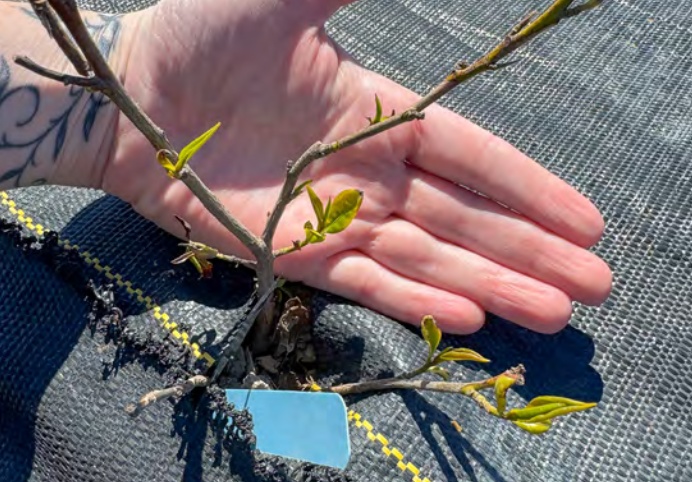
After tea plants are transplanted in the field (see Planting and Establishment Guide), do not prune in the first year. Tea plants may lose all their leaves and look dead after their first and second winters. Do not remove or prune the plants as they likely will regrow new leaves and shoots in the summer (Fig. 1). If you are in a colder area, it may take two winters for plant establishment. By the third year, plants should be cold-hardy and will remain evergreen throughout the year.
In the second summer, if plants survive well through the winter, they likely will be about 12 to 16 inches tall and be ready for pruning. Avoid pruning if plants show signs of stress (chlorosis, browning, wilting, leaf drop, etc.) or lack of new growth. Pruning decisions are made based on how the plants are growing. For instance, if tea plants still appear very small and have not initiated much lateral branching in the second summer, it may be better to prune in the third summer. Alternatively, plants that grow very tall (to the point of tipping over) may warrant earlier pruning.
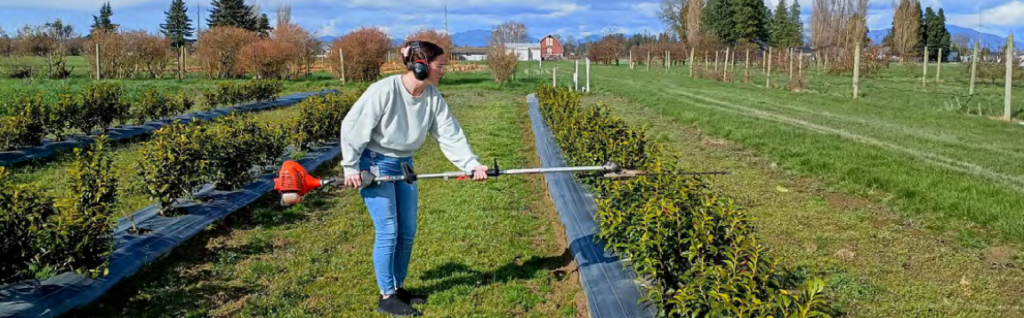
Never prune more than a third of a tea plant’s height at any given time. Pruning may be done with handheld clippers, particularly for container plantings. However, pruning shears or a hedge trimmer (Fig. 2) may be more convenient for a row of tea plants.
To produce tea plants that are even in height, prune all plants to the height of the shortest plant, as long as no more than a third of the tallest tea plant is removed. If there is a large disparity between the tallest and shortest tea plants, choose an intermediate height that makes the plants as uniform as possible, and prune plants so they are the same height the next year. During the initial years of plant establishment, pruning for plant height management is more important than pruning lateral growth. Pruning plant height disrupts apical dominance and encourages the desired ‘bushy’ growth that forms the plucking table with a high density of picking points.
For western Washington and similar climates, do not prune later than October or earlier than March, as this may leave plants susceptible to cold injury.
In the following 3 years after establishment, prune tea plants up to three times a year (March, June, and September), based on plant growth and health, to shape the plucking table. To avoid cold damage to plants, the first pruning event of the year should be after the chance of freezing temperatures has passed, and the last pruning should be about 1 month prior to the first hard frost.
Do not prune tea plants or pick leaves in late autumn or winter (November through February). Plants may be severely impacted by cold injury, and the root system may be weakened.
Maintenance Pruning
Once the tea plants are mature, about 5 years after transplanting in western Washington, maintenance pruning can be done annually or every 2 years. In addition to the 1 – 3 plucking table pruning events described above, remove dead, diseased, or damaged branches.
Flower Bud Removal
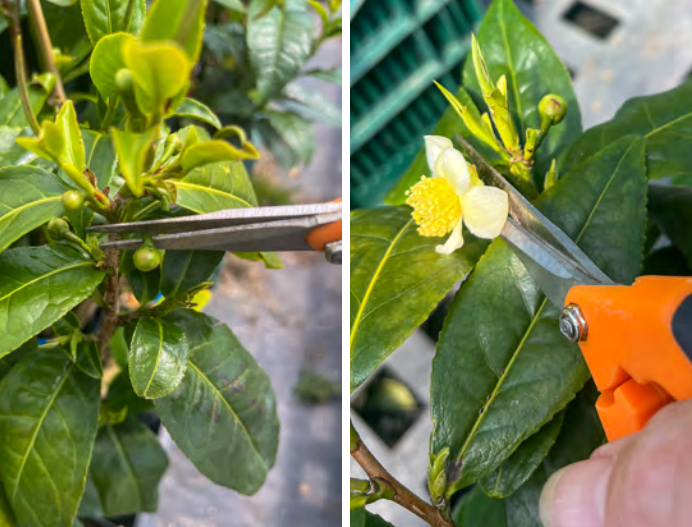
Depending on the tea cultivar, flower buds may begin to form alongside new leaves. Tea plant flowers have white petals and yellow stamens and are generally small but attractive. However, flower production reduces vegetative growth. Hence, to focus on leaf production, remove flowers as soon as they appear. Use clippers to cut directly behind the flower bud head or flower (Fig. 3). Take care to avoid clipping leaf axils or damaging the growing point on the stem.
Winter Protection
Tea plants generally survive temperatures slightly below freezing, however the leaves may be damaged or killed, especially in their first and second winters. If there is an extended freeze period, longer than 4 to 5 days, or if the temperature drops below 15 °F (-10 °C) for more than 24 hours, cover plants with a row cover (e.g., AgroFabric, Alpharetta, GA) or a plastic sheet to prevent cold injury. If there is rain in addition to freezing temperatures, make sure the cover does not touch the plant directly as the cover will freeze to the leaves and cause damage to the plant. Use stakes or a frame to support the cover.
Tea plants growing in containers should be moved into a greenhouse or indoors on days with freezing temperatures. If needed, wrap the pot with insulating material to prevent the plant’s root system from freezing. Excessive wind, especially when very cold, adversely affects tea plants. Windbreaks can prevent cold damage, high evapotranspiration, and water stress.
Please note: The recommendations in this document are based on the care and management that we provide tea plants at WSU Northwestern Washington Research and Extension Center in Mount Vernon, WA. The practices included here have been successful thus far in our tea planting. This document will be updated as we continue to learn and adapt our practices based on plant health and growth.
References and Further Reading
- Cowan-Gore I, Sein TT. 2020. Myanmar tea cultivation and processing guide (PDF). Strengthen Publication
Series. https://www.ilo.org/sites/default/files/wcmsp5/groups/public/%40ed_emp/%40ifp_skills/documents/publication/wcms_742461.pdf - Enroth C. 2022. Growing tea in Illinois. University of Illinois Urbana-Champaign. https://extension.illinois.edu/blogs/good-growing/2022-11-03-growing-tea-illinois. [accessed 8 Jul 2025].
- Zee F, Sato D, Keith L, Follett P, Hamasaki RT. 2003. Small-scale tea growing and processing in Hawaii (PDF). University of Hawaii at Manoa Cooperative Extension Service. NPH-9. https://www.ctahr.hawaii.edu/oc/freepubs/pdf/nph-9.pdf




This material is based upon work that is supported by Washington State Department of Agriculture Nursery Grant. Any opinions, findings, conclusions, or recommendations expressed in this publication are those of the author(s) and do not necessarily reflect the view of the Washington State Department of Agriculture. Product information is provided as examples in this publication and is not intended to endorse these products. Similar products that function the same can be used.