Using Sweetpotato Greens
Using Sweetpotato Greens: Livestock Feed
Authors: Gracia Puerto, Jessica Weaver, Carol Miles
Affiliation: Washington State University Northwestern Washington Research and Extension Center
https://vegetable.wsu.edu/sweetpotato
Introduction
Sweetpotato vines are not just a valuable food crop for humans, they also offer significant nutritional and economic benefits as animal feed. Grasses provide less protein than the animals require, and availability tends to be scarce during the winter months. Sweetpotato vines can be fed fresh before they deteriorate in nutritional value. The leaves and vines contain a high amount of soluble dietary fiber, a high number of amino acids, and minerals that are essential for the proper development of livestock. They can also be used as a supplement or as a replacement for more expensive feed ingredients, making them both resourceful and cost-effective for livestock owners. Feeding sweetpotato vines to animals also reduces agricultural waste and supports more efficient use of farm crops (Figure 1). However, special considerations need to be addressed when sweetpotato vines are used as a primary nutritional source for livestock.
Nutritional Benefits
Sweetpotato greens crude protein content ranges from 10.82 to 20.58% on dry matter (DM) basis, which meets and exceeds the protein requirement for ruminants (Baba et al. 2017). The crude protein content of the leaves ranges from 26 to 33%, while stems contain 10 to 14% on DM basis (Ishida 2000; Tsegaye et al. 2024). Sweetpotato vines also have high digestibility (>62%) (Chen et al. 2024) and high moisture content when fed
fresh. For example, 100 kg of dried sweetpotato vines can supply 10 to 12 kg of protein (Murugan et al. 2012).
Sweetpotato vines also offer good feeding value due to their relatively moderate neutral detergent fiber (NDF) content, which is 44.84% on dry matter basis (Chen et al. 2024). Fiber is essential for ruminants, as it supports
proper rumen function. Sweetpotato leaves are rich in beta carotenoids, which serve as precursors for vitamin A. Leaves also contain relatively high levels of riboflavin, ascorbic acid, and folic acid (Woolfe 1992). Mineral content in sweetpotato vines primarily includes calcium, iron, and zinc, with higher concentrations found in fully mature leaves (Woolfe 1992).
For producers already growing sweetpotatoes or with access to sweetpotato vines, feeding them to livestock can be budget-friendly, providing an additional source of nutrition with minimal added cost, unless the vines are
further processed.
How to Feed Sweetpotato Greens
A good feed alternative or supplementation must be both nutritious and with a good intake potential. Sweetpotato vines can be fed fresh, wilted, dried, or ensiled. Processing sweetpotato vines can alter their nutritional content. For example, ensiling improves feed efficiency by increasing protein availability through nitrogen conversion during fermentation. It also reduces trypsin inhibitors, which can negatively impact protein digestibility. However, beta-carotenoids and water-soluble vitamins may degrade during processing.
Feeding Considerations
The amount, form (e.g., fresh, wilted, etc.), and frequency of feeding sweetpotato vines depend on several factors, including the animal’s age, breed, production stage, current diet, and metabolism. Initially, it is suggested to expose the animals to the vines to determine desirability and palatability. Then, based on the animal’s dietary needs, the optimal amount and form of the feed including sweetpotato vines should be adjusted accordingly. For cattle, small ruminants, and poultry, chopped fresh sweetpotato vines can be mixed with their regular feed. In swine, especially in parts of Asia where energy feeds are limited, a combination of vines and roots is commonly used.
Real Life Example
Harvest and Transportation
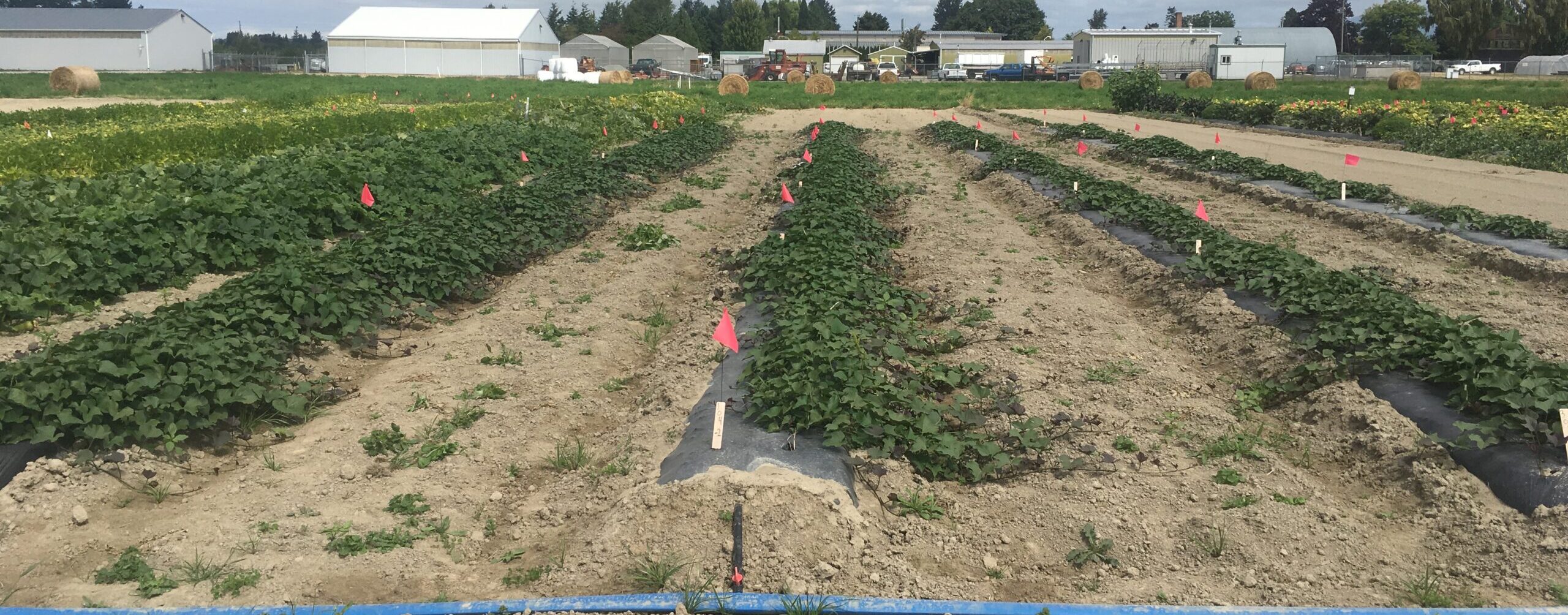
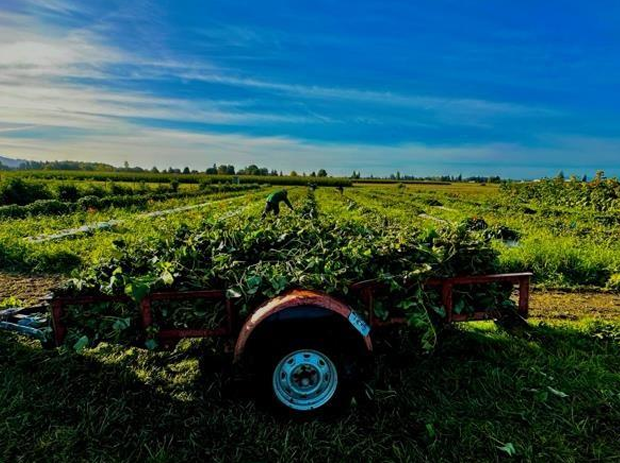
A sweetpotato variety trial was planted at the Washington State University Northwestern Washington Research and Extension Center (WSU NWREC) on June 4, 2024. Sweetpotato vines were harvested in early October (Figure 2). At time of harvest, the vines were heavy due to their high moisture content and heavy dew. Vines were cut at the soil surface and around 500 pounds of vines were loaded into a trailer and transported 9 miles to a farm in Mount Vernon owned by Mr. Wayne Hill, for this livestock feeding test (Figure 3).
Feeding Time
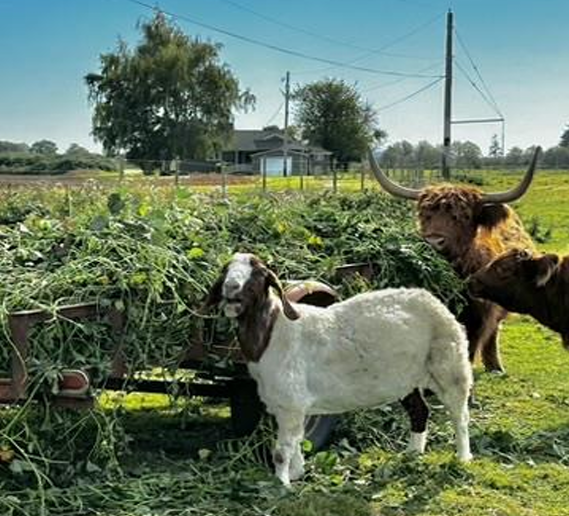
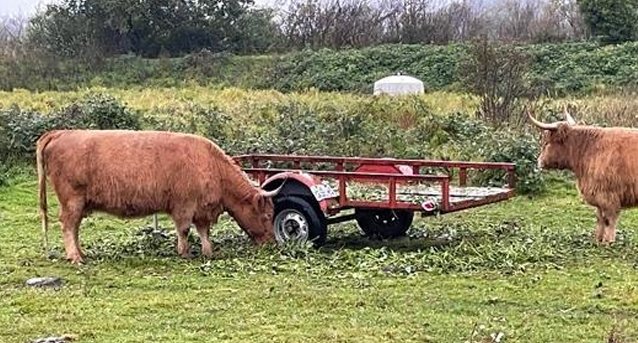
The trailer with sweetpotato vines arrived at a pasture area where the farm’s animals had free access to a pasture mix, canary grass, and water (Figure 4). One horse, two Scottish Hylander cow calf pairs, one Scottish Hylander heifer, and one goat were in the pasture. Overall, it took less than thirty seconds for all the animals to reach the trailer and start sniffing the sweetpotato vines. Their feeding behavior was recorded for 2 hours. The same day the sweetpotato vines arrived in the pasture, late evening time, a Scottish Hylander bull was introduced into the herd.
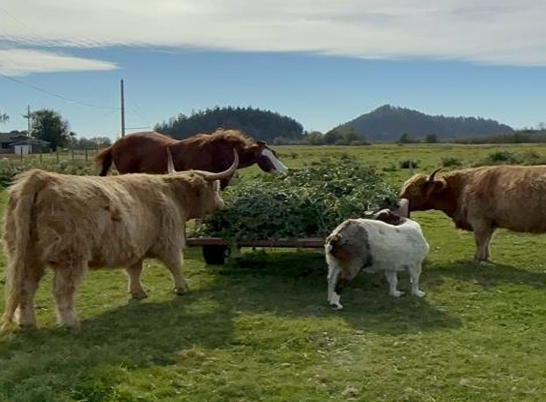
with the sweetpotato vines.
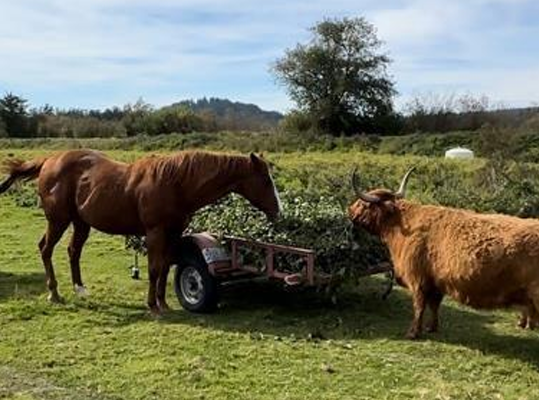
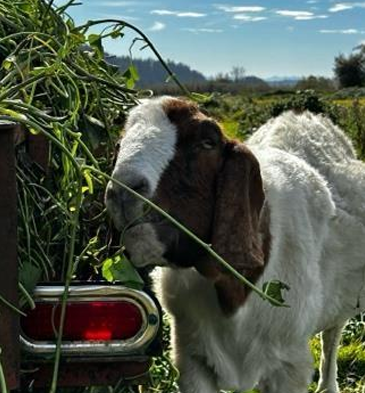
The horse was very interested in the trailer with the sweetpotato vines when it arrived at the pasture, but after a few sniffs and some bites, he lost interest and moved away (Figure 5). The goat is the recognized alfa animal of the group and also the oldest of all the animals. The goat was one of the first animals to approach the trailer and one of the last to move away (Figure 6). As a highlight, its feeding behavior showed preference only for the sweetpotato leaves; it ate the leaves off the vines, leaving the vines hanging from the trailer.
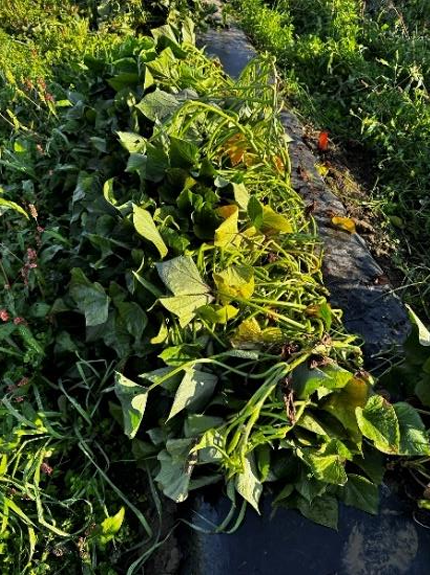
Around 16 hours after the trailer arrived, on October 4, Mr. Hill took a photo of the trailer when he went to check on the animals and it was empty (Figure 7). It is of special note that despite a new bull arriving in the pasture area the same evening as the sweetpotato vines arrived, the feeding behavior of all the animals remained strong, including for the new bull. It is generally expected their eating behavior would decrease due to stress from being transported, entering a new herd, and from modified commingling.
The Farmer
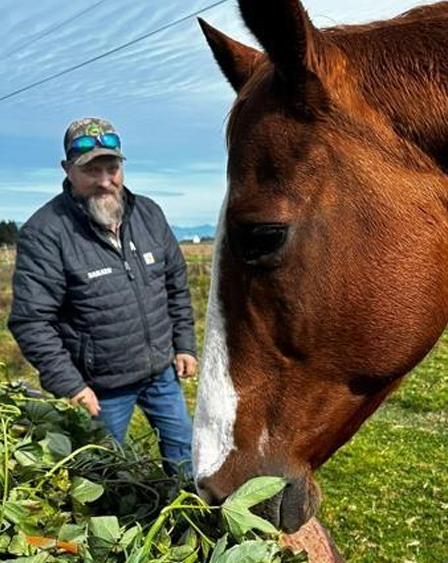
Mr. Hill was born and raised in Skagit County; he is a fourth-generation farmer (Figure 8). His great-grandparents came from Sweden and settled here, and his family has been farming ever since. He is a second generation working for Sakata Seed America, Inc. (Burlington, WA), where his mother also worked. His family had a beef farm in the 1920s and 30s, and the last cow left the farm in the 1960s. His family became crop farmers, and eight years ago he started raising pheasants, which was profitable but a lot of work. In 2019, he and his wife decided to stop raising pheasants and they purchased three goats to clean the land. Next, they purchased two Scottish Hylander cows and a one-year-old heifer, that turned three years old the day before we did the sweetpotato vine feeding test.
They are now in the process of breeding the cows and temporarily keeping a bull for this purpose. The long-term goal is to produce beef, but for now, they raise the cows essentially as pets, which has a large market opportunity. They can easily sell the cows as pets and make just as much money as with beef, without having to slaughter the animals.
Mr. Hill enjoys raising his livestock, and a very special memory for him was how special it was for his father to see the cows on the farm before he passed away last spring. “It was fortunate because he remembered when the last cows left the farm, so he was pretty excited. I’ve been seeing again the land used like it used to be”. Mr. Hills’ previous experience with animals has been mainly with horses, and he has only had cows the last two years. The cows have been a learning experience for him and his family. From his experience, Hylanders are very easy to raise, though they are slow to gain weight compared to other breeds. So far, the only issue he has experienced with the cows has been flies this year, but no diseases as yet. Overall, the Scottish Hylander herd has been very mellow and easy to raise. The animals are mainly fine as long as they have grass available. From November until March, they will start feeding silage bales, until the grass starts to grow again.
Special thanks to Mr. Wayne Hill for opening his doors so we could do this test. Thank you for your time and all the useful information you shared that helped us describe your farm and livestock. Thanks also to Don McMoran, Director of the WSU Skagit County Extension office, for connecting us with Mr. Hill.
References
Baba M, Nasiru A, Saleh Kark I, Rakson Muh I. 2017. Nutritional evaluation of sweet potato vines from twelve cultivars as feed for ruminant animals. Asian Journal of Animal and Veterinary Advances. 13(1):25-29. https://doi.org/10.3923/ajava.2018.25.29.
Chen H, Sun Q, Tian C, Tang X, Ren Y, Chen W. 2024. Assessment of the nutrient value and in vitro rumen fermentation characteristics of garlic peel, sweet potato vine, and cotton straw. Fermentation. 10(9):464. https://doi.org/10.3390/fermentation10090464.
Ishida H, Suzuno H, Sugiyama N, Innami S, Tadokoro T, Maekawa A. 2000. Nutritive evaluation on chemical components of leaves, stalks and stems of sweet potatoes (Ipomoea batatas poir). Food Chemistry. 68(3):359-367. https://doi.org/10.1016/S0308-8146(99)00206-X.
Murugan S, Paramasivam SK, Nedunchezhiyan M. 2012. Sweet potato as animal feed and fodder. Fruit, Vegetable and Cereal Science and Biotechnology, Global Science Books. 6(1):106-114.
Tsegaye K, Mekasha Y, Bayssa M. 2024. Effects of varieties and harvest stages on silage qualities of sweet potato vines. Tropical and Subtropical Agroecosystems. 27(3):107. http://doi.org/10.56369/tsaes.5470.
Woolf J. 1992. Sweet potato: an untapped food resource. Cambridge University Press, New York, NY, USA.
This material is based upon work that is supported by the National Institute of Food and Agriculture, U.S. Department of Agriculture, under award number 2022-38640-37490 through the Western Sustainable Agriculture Research and Education program under project number SW23951. USDA is an equal opportunity employer and service provider. Any opinions, findings, conclusions, or recommendations expressed in this publication are those of the author(s) and do not necessarily reflect the view of the USDA.