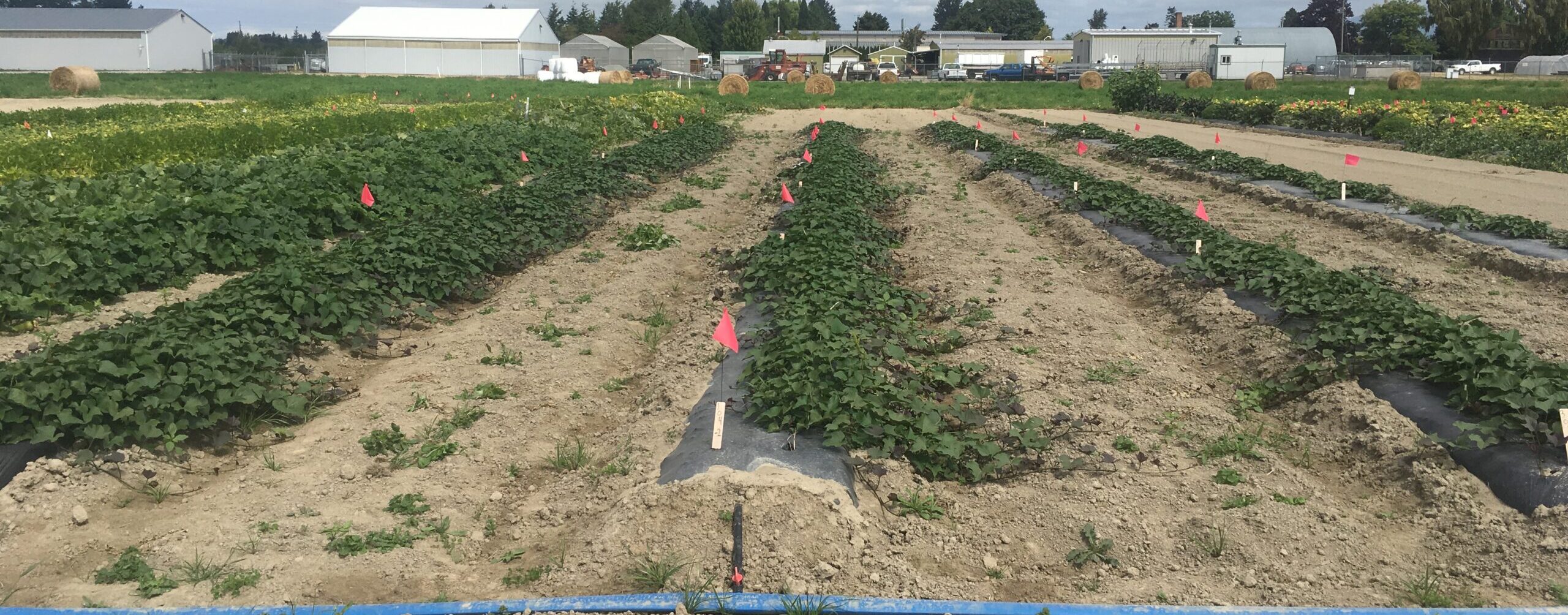
Research Protocol
Sweetpotato: Measuring Brix Using an Electronic Refractometer
Authors: Jessica Weaver, Laura Schulz, Jordan White, Carol Miles
Affiliation: Washington State University Northwestern Washington Research and Extension Center
https://vegetables.wsu.edu/sweetpotato/
December 2025
Introduction
Brix measures the amount of total soluble solids in a liquid, which are primarily sugars for fruit and vegetables. Brix measurements provide a quick and easy method to quantify sweetness and important information that can help account for consumer preferences based on flavor. This can assist farmers in deciding which sweetpotato cultivars to plant. Brix measurements can also be used to measure curing efficacy after harvest, as carbohydrates tend to be converted to sugars with curing.
Supplies
- Knife – for cutting sweetpotato roots
- Cutting board – for cutting sweetpotato roots
- Sealable plastic bags – for storing root samples
- Sharpie – for labeling bags
- Freezer – for freezing samples
- Towel – for thawing samples
- Electronic refractometer – to measure soluble solids of sweetpotato juice, e.g.:
- HANNA Instruments, Digital Refractometer for Brix Measurement in Food – HI96801
- Deionized water – for rinsing refractometer sample window
- Kimwipes or tissues – for blotting the sample window dry, e.g.:
Sample preparation
- Select healthy-looking US no. 1 sweetpotato roots for sampling. Since Brix naturally varies between roots, even of the same cultivar, it is recommended to sample at least 4 roots per cultivar or treatment, or 1 root per research plot.
- Wash outside of roots thoroughly with water.
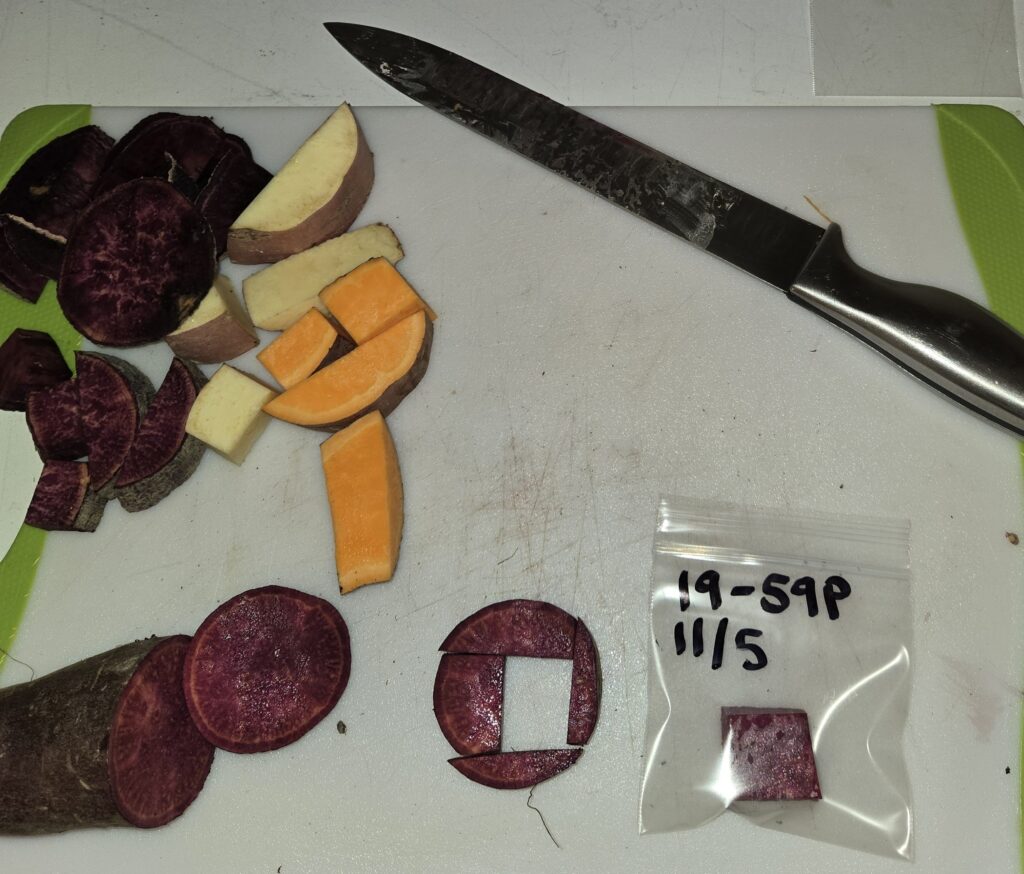
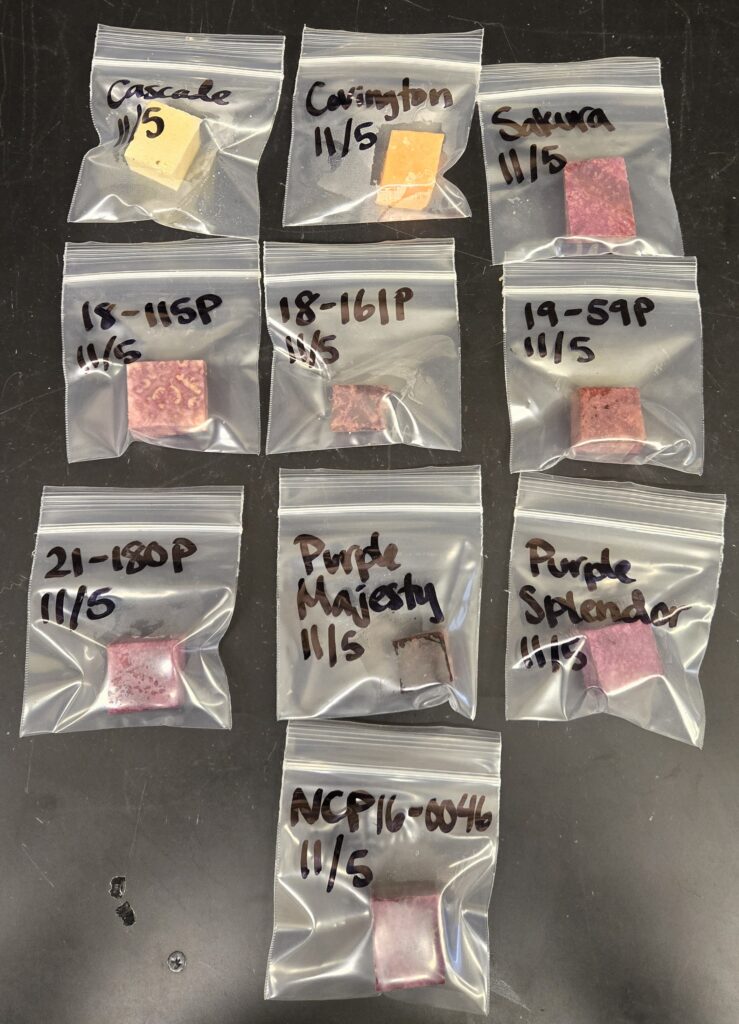
- Cut a 1-inch slice from the center of the root and cut a cube from the center of the slice (Figure 1). Place the cube in a small sealable plastic bag labeled with the date, entry, or sample number, or cultivar, and any other necessary identifying information (Figure 2).
- Place all samples from the same date into a larger plastic bag labeled with the date.
- Place the bag of samples in the freezer for at least 3 days.
Thawing samples
- Remove bags of samples from the freezer and place on a towel at room temperature just until thawed. Analyze all samples on the same day once they have reached room temperature.
Brix measurements with electronic refractometer
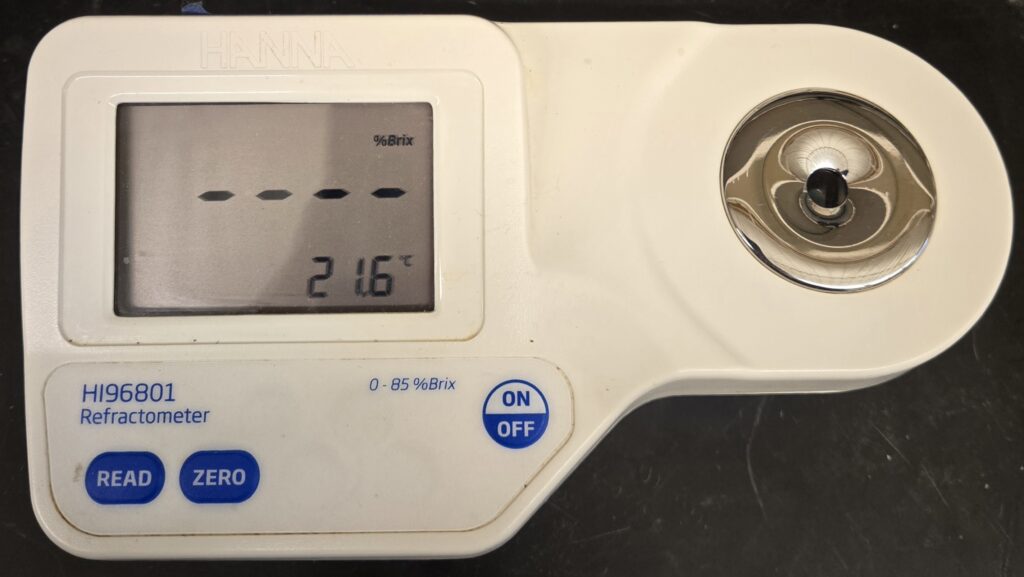
- Press the “on” button to turn on the refractometer (Figure 3).
- Put 2–3 drops of deionized water onto the small glass window on the right side of the refractometer (the smaller circle inside of the metal circle), adding just enough water to cover the glass window (Figure 3).
- Once water is on the small glass window, press “zero”.
- Take a tissue and blot dry the water from the window.
- Squeeze the sweetpotato cube in the bag so that juice is released. Open the bag and carefully pour a few drops of juice onto the refractometer until the small glass window is covered (Figure 4). The juice should not contain solids.
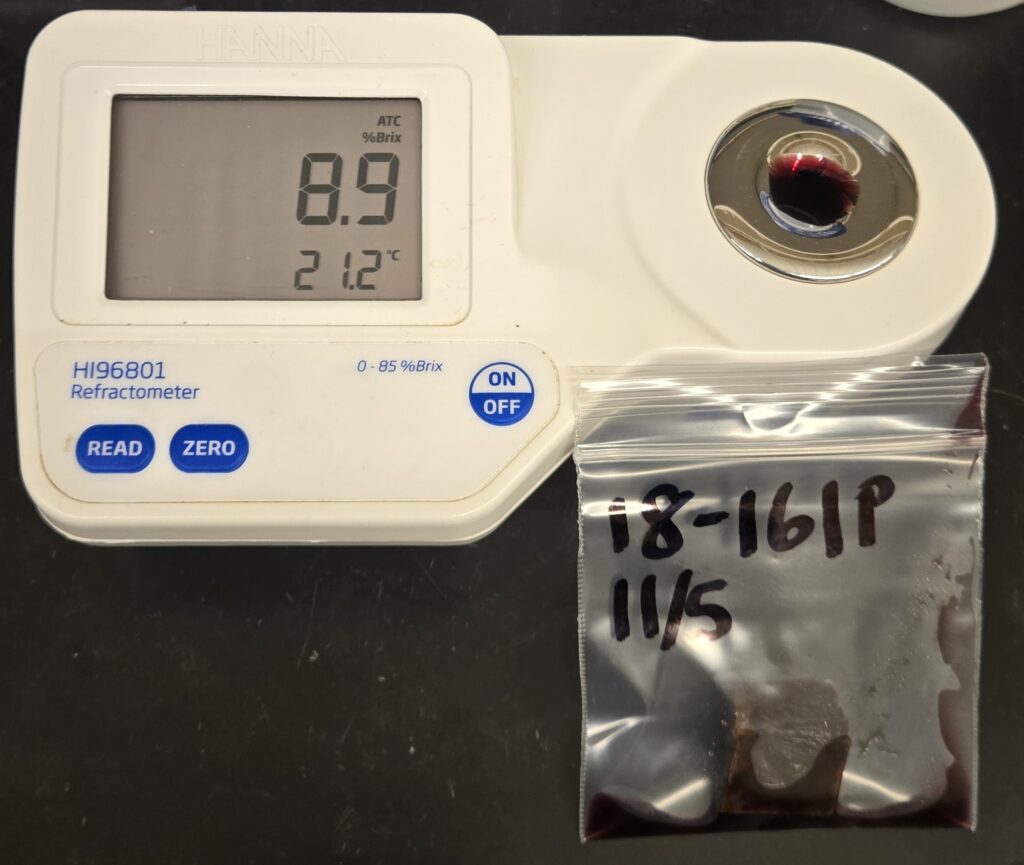
- Press the “read” button.
- Enter the Brix value into your spreadsheet.
- Use a tissue to clean the juice off the window.
- Put a few drops of deionized water on the window and clean well. Blot dry with a tissue.
- Repeat steps 11–15 for each sweetpotato sample.
- Zero the Brix meter after 15 readings.
- If “ELT” error is displayed, try covering the window with your hand and click “read” again. If issue continues, wipe off juice, clean the window and reapply the juice.

The information in this publication is based upon work that is supported by the U.S. Department of Agriculture, National Institute of Food and Agriculture, under award number G200-25-WB305 through the Western Sustainable Agriculture Research and Education Program under project number WPDP25-003, and Hatch Project WNP0010 Accession 7005372. Any opinions, findings, conclusions, or recommendations expressed in this publication are those of the author(s) and should not be construed to represent any official USDA or U.S. Government determination or policy, and are not meant to endorse any businesses or detract from any not listed.