Research Protocol
Sweetpotato: Measuring Longest Vine
Authors: Jessica Weaver, Laura Schulz, Jordan White, Carol Miles
Affiliation: Washington State University Northwestern Washington Research and Extension Center
https://vegetables.wsu.edu/sweetpotato/
December 2025
Introduction
Longest vine length at the end of the growing season is used to determine the growth habit of the sweetpotato plant. Sweetpotato growth habit as defined by Huamän (1991) is:
- Erect <75 cm
- Semi-erect 75–150 cm
- Spreading 151–250 cm
- Very spreading >250 cm
These classifications are useful for providing cultivar descriptions to farmers, who may prefer erect or semi-erect types for improved competition with weeds in the row, to allow for weed cultivation between rows longer into the growing season, and/or for cultivation in small spaces or with narrow between-row spacing.
Supplies
- Meter stick — to measure vine length
- Clip board — to hold data sheet
- Data sheet — to record vine length
- Pencil — to write vine length
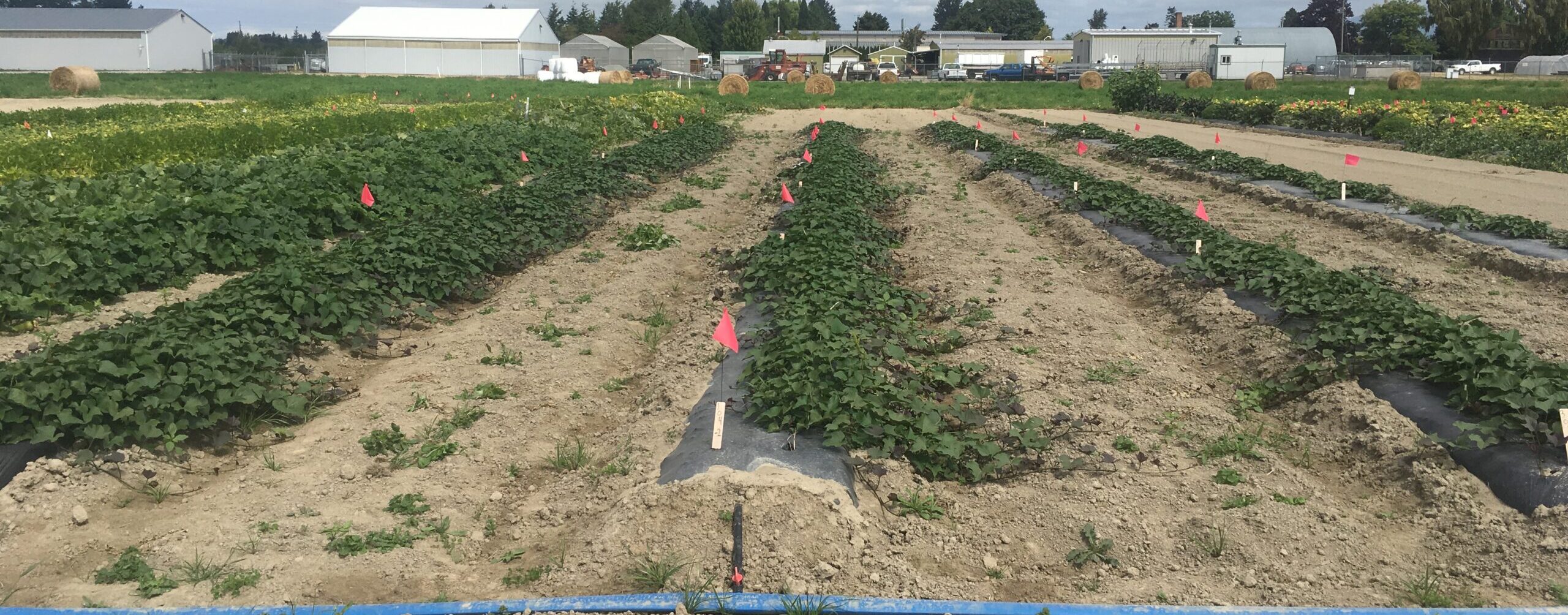
Experimental plot set up
Collect the longest vine data from the central plants in each plot. For example, if an experiment has 15 plants per plot, collect vine length data for the central 5 plants. If an experiment has 10 plants per plot, collect data for the central 4 plants.
Steps to measuring vine length
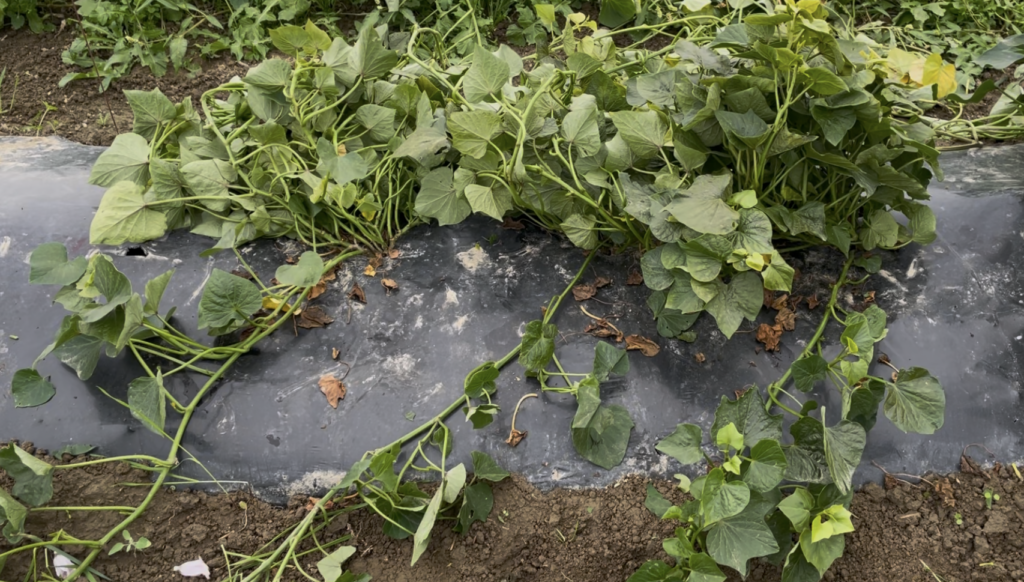
- Separate vines on a plant and visually compare to identify the longest vine. Separate the longest vine from other vines on the plant (Figure 1).
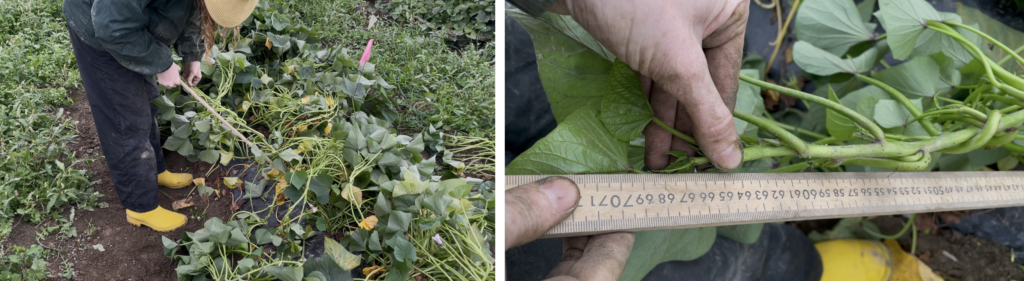
- Place the meter stick at the base of the vine and measure the length of the vine to the base of the terminal bud. Do not include the leaves at the vine tip (Figure 2).
- Record the length in centimeters.
- Repeat the measurement for all data collection plants in each plot throughout the experiment.
- Calculate the average longest vine length for each plot and use the average values for data analysis.
References
Huamén Z. 1991. Descriptors for sweet potato. International Board for Plant Genetic Resources, Rome, Italy.
https://www.genesys-pgr.org/descriptorlists/a0cf4935-30fd-4de4-b34f-37aa31e26cad.

The information in this publication is based upon work that is supported by the U.S. Department of Agriculture, National Institute of Food and Agriculture, under award number G200-25-WB305 through the Western Sustainable Agriculture Research and Education Program under project number WPDP25-003, and Hatch Project WNP0010 Accession 7005372. Any opinions, findings, conclusions, or recommendations expressed in this publication are those of the author(s) and should not be construed to represent any official USDA or U.S. Government determination or policy, and are not meant to endorse any businesses or detract from any not listed.