Research Protocol
Sweetpotato: Measuring Root Yield
Authors: Jessica Weaver1, Laura Schulz1, Jordan White1, Steven Young-Uhk2, Carol Miles1
Affiliation: 1Washington State University Northwestern Washington Research and Extension Center; 2College of Micronesia, Federal States of Micronesia
https://vegetables.wsu.edu/sweetpotato/
December 2025
Introduction
Yield of sweetpotatoes is a critical measurement to determine suitability of a cultivar for a production region and potential profitability. Such information can assist farmers in deciding which cultivars to plant and estimate potential profits based on the number and size of roots produced. The USDA created a scale based on root length and diameter to categorize sweetpotato sizes, and farmers can calculate potential profits based on the number of roots in each grade.
Supplies
- Grading racks – to separate roots by size
- Scale – to weigh roots
- Crates – to organize roots by category
Root grading set up
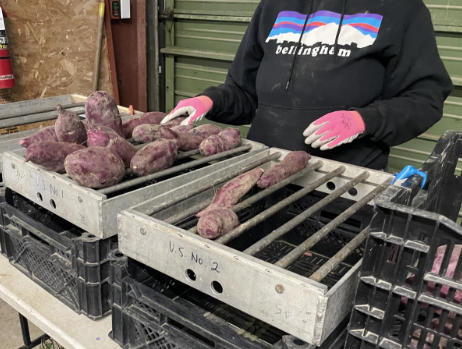
Use grading racks to easily separate roots based on their diameter. Create your own grading racks with locally available materials. We custom-made racks with metal bars (dowels) that are separated by the minimum diameter for each grade (Figure 1). While our racks are made from metal, racks could be made with a wood frame and dowels.

Building a Grading Rack
The grading rack on the left of Figure 1 was constructed using a frame made from standard 2×4 lumber with an outside width of approximately 24 inches. Half-inch wooden dowels were cut to 24-inch length and laid across the top of the frame, then secured to the frame using 1-inch common nails.
The grader was built as one long rack with each grading section. Sections for each grade were separated using ¾-inch × 1-inch wooden divider strips installed across the frame. Within each section, dowels were spaced according to the minimum diameter for each sweetpotato grade.
Four grading sections were included and arranged from largest to smallest spacing: jumbo, US no. 1, US no. 2, and fingerling. The grading rack allows sweetpotatoes to be quickly separated by size during harvest for yield measurements.
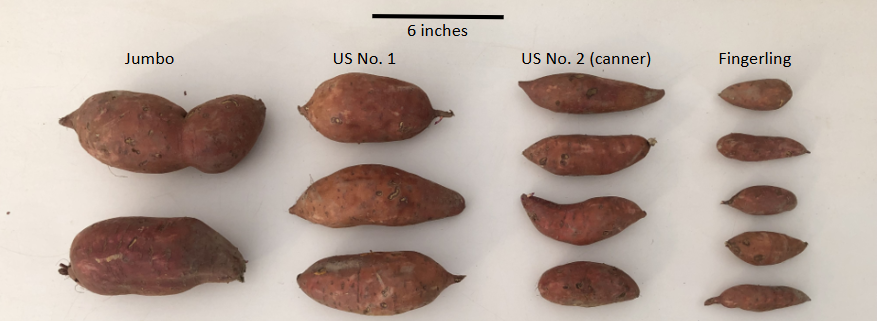
USDA Sweetpotato Grading Scale (USDA 2005) (Figure 2):
- Jumbo: >22.9 cm length and >8.9 cm diameter
- US no. 1: 7.6–22.9 cm length and 4.4–8.9 cm diameter
- US no. 2 (canner): 3.8–4.4 cm diameter
- Fingerling: 7.6–10.2 cm length and 2.5–3.8 cm diameter; while this is not an official USDA size category, it is a market category for farmers
- Cull: off shape or damaged roots that would otherwise be US no. 1, US no. 2/canner, or jumbos roots
Steps to grade sweetpotatoes
- Label one crate per size category.
- Measure yield for each plot separately, one plot at a time.
- If the sweetpotato is damaged or off shape, place it in the cull crate.
- Place a sweetpotato on the grading rack starting with the jumbo rack. If the root does not fall through the bars, place it into the crate labeled jumbo.
- If the sweetpotato falls through the jumbo grate, move it to the US no. 1 rack.
- If the sweetpotato does not fall through the US no. 1 rack, place it in the crate labeled US no. 1. If it does fall through, move it to the US no. 2 rack (Figure 3).
- If the sweetpotato does not fall through the US no. 2 rack, place it in the crate labeled US no. 2. If it does fall through, determine if the sweetpotato measures at least 7.6 cm length and 2.5 diameter. If so, place it in the fingerling crate.
- If the sweetpotato is off-shape or damaged place it the cull crate.
- Discard any roots less than 7.6 cm in length and 2.5 cm in diameter.
- Once all the sweetpotatoes in the plot have been sorted by size, count the number of sweetpotatoes in each crate and record the number of roots by grade.
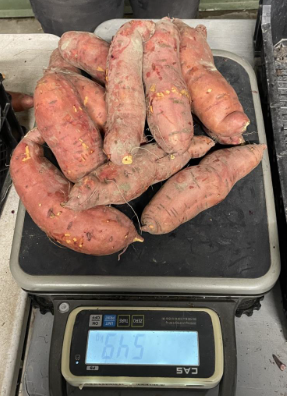
- Place the sweetpotatoes that are in each grade on a scale and record the weight by grade (Figure 4).
References
US Department of Agriculture, Agricultural Marketing Service. 2005. Sweetpotato grades and standards. https://www.ams.usda.gov/grades-standards/sweetpotatoes-grades-and-standards.

The information in this publication is based upon work that is supported by the U.S. Department of Agriculture, National Institute of Food and Agriculture, under award number G200-25-WB305 through the Western Sustainable Agriculture Research and Education Program under project number WPDP25-003, and Hatch Project WNP0010 Accession 7005372. Any opinions, findings, conclusions, or recommendations expressed in this publication are those of the author(s) and should not be construed to represent any official USDA or U.S. Government determination or policy, and are not meant to endorse any businesses or detract from any not listed.