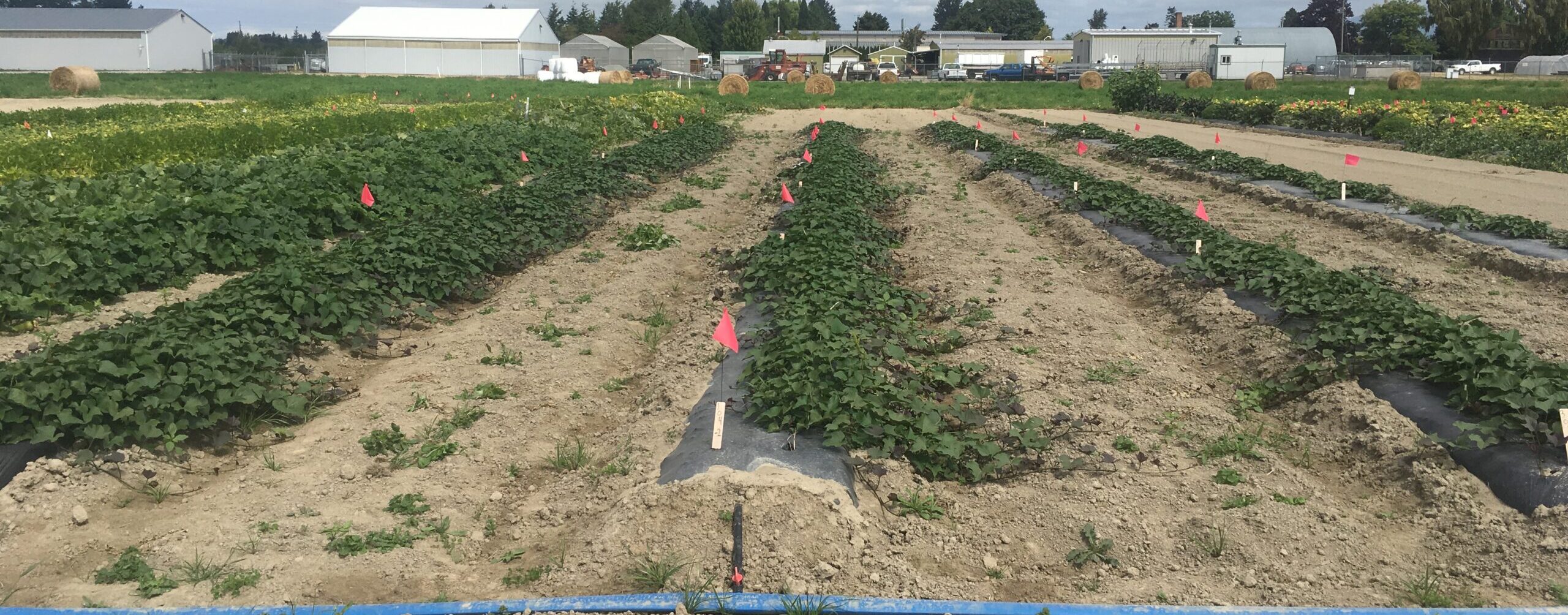
Research Protocol
Sweetpotato: Measuring Root Damage with the Wireworm-Diabrotica-Systena (WDS) Severity Index
Authors: Jessica Weaver, Laura Schulz, Jordan White, Carol Miles
Affiliation: Washington State University Northwestern Washington Research and Extension Center
https://vegetables.wsu.edu/sweetpotato/
December 2025
Introduction
Wireworms are the larval stage of click beetles (Agriotes lineatus, A. obscurus, and Limonius canus) and are a primary pest in western Washington that can cause extensive damage to sweetpotato roots. The Wireworm-Diabrotica-Systena (WDS) severity index counts damage from wireworms and damage from striped cucumber beetle (Diabrotica spp.) and flea beetle (Systena spp.) larvae. Evaluating cultivars for this damage will help farmers select the right cultivar to grow on their farm and produce marketable sweetpotatoes even when these insects are present in the field. The WDS severity index provides a simple, accessible measurement that can be used to compare and determine which cultivars would be the most suitable for production based on insect pressure. This method does not distinguish between damage caused by different insect pests, as the damage from these insect pests is virtually indistinguishable from each other and all damage can cause roots to be unmarketable.
Supplies
- Shovel – to dig up sweetpotato roots for sampling
- Hose – to wash roots
- Crates – to sort roots, 1 crate per damage category, 4 total
- Scale – to weigh roots in each damage category
Experimental set up
Wireworm-Diabrotica-Systena severity index (Schalk et al. 1993):
- 0 = no insect scars/holes
- 1 = between 1 and 5 insect scars/holes
- 2 = between 6 and 10 insect scars/holes
- 4 = more than 10 scars/holes
There is no number 3 rating on this scale. This is to provide a weighted rating as a root with 10 or more holes is considered unmarketable.
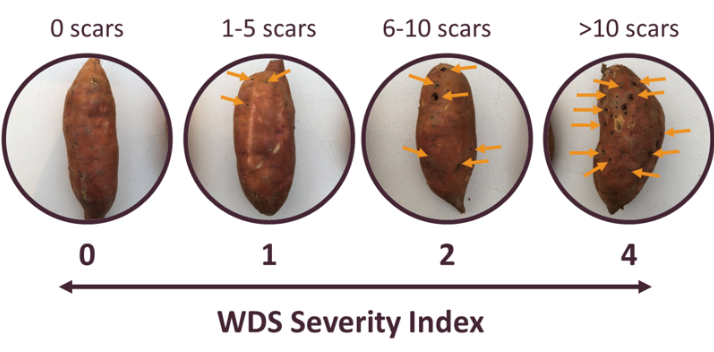
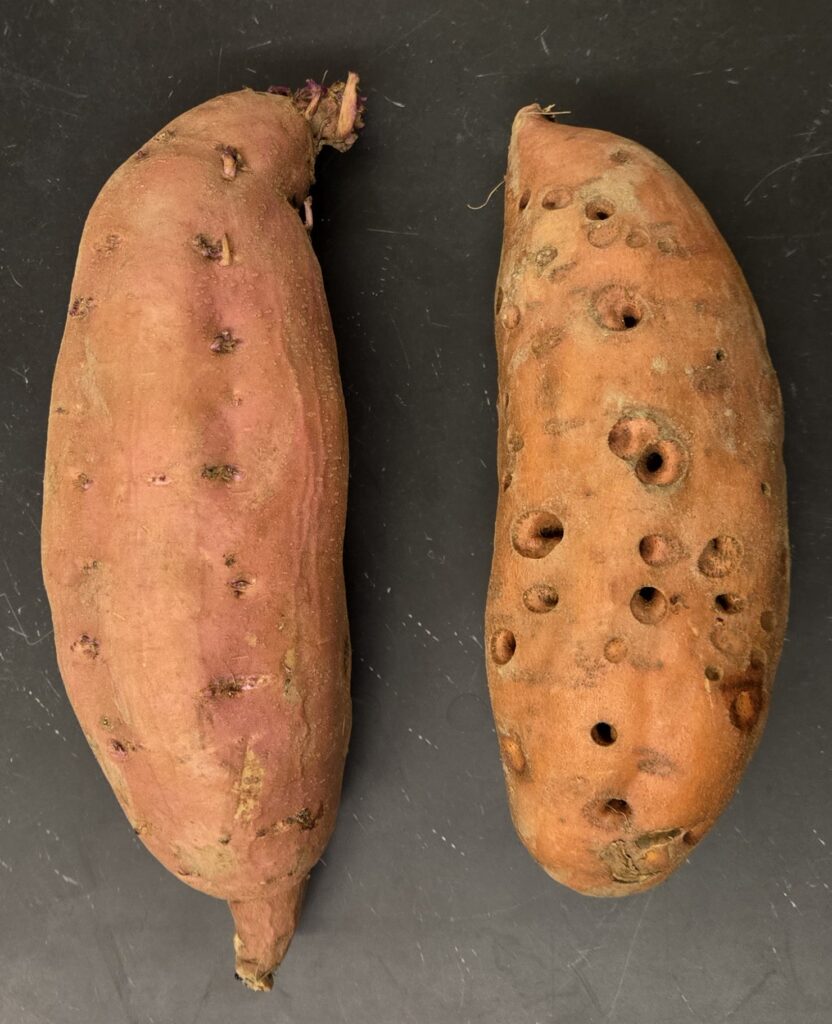
Note: Insect scars can vary in appearance due to timing of damage and other factors. Do not count “pinprick” scars smaller than 1 mm in diameter, as these do not affect the marketability of sweetpotatoes. Do not count root nodes, which may appear as shallow indents but are not caused by wireworms (Figure 2).
Assessing insect damage
- Carefully hand harvest roots from the plants for data collection. Harvest 5 plants per location in a field and sample 4 locations per field. If an experiment, measure damage immediately after roots in each plot have been measured for yield.
- Wash roots with water by spraying with a hose. Removing dirt makes it easier to see WDS scars.
- Set up crates, labeled: 0 scars, 1–5 scars, 6–10 scars, >10 scars.
- For each sweetpotato in a field sample or plot:
- Observe the sweetpotato skin fully by rotating the root 360 degrees.
- Count the number of insect scars.
- Place the sweetpotato into the corresponding crate by number of insect scars.
- Count the number of sweetpotatoes in each category and record the value for each sample or plot.
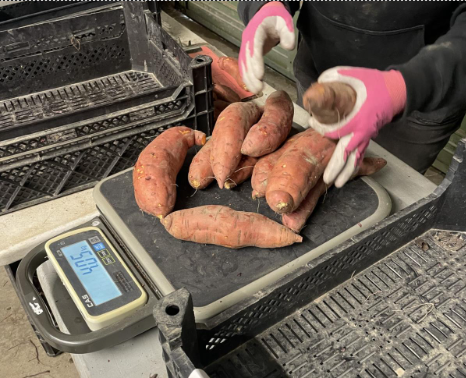
- Weigh the sweetpotatoes in each category and record the value for each sample or plot (Figure 3).
- Repeat steps 4–6 for each sample.
- Calculate WDS Index for each sample using the following equation:

Where: N1−5=number of roots with 1−5 scars
N6−10=number of roots with 6−10 scars
N>10=number of roots with >10 scars
Ntotal=total number of roots
References
Schalk J, Bohac J, Dukes P, Martin W. 1993. Potential of non-chemical control strategies for reduction of soil insect damage in sweetpotato. Journal of the American Society for Horticultural Science. 118(5):605-608. https://doi.org/10.21273/JASHS.118.5.605.

The information in this publication is based upon work that is supported by the U.S. Department of Agriculture, National Institute of Food and Agriculture, under award number G200-25-WB305 through the Western Sustainable Agriculture Research and Education Program under project number WPDP25-003, and Hatch Project WNP0010 Accession 7005372. Any opinions, findings, conclusions, or recommendations expressed in this publication are those of the author(s) and should not be construed to represent any official USDA or U.S. Government determination or policy, and are not meant to endorse any businesses or detract from any not listed.