Growing Sweetpotatoes in Western Washington
Sweetpotato Curing and Storage
Authors: Laura Schulz1, Laurel Moulton2, Samantha Grieger2, Jordan White1, Jessica Weaver1, Srijana Shrestha3, Carol Miles1
Affiliation: Washington State University, 1Northwestern Washington Research and Extension Center, Mount Vernon; 2Extension; 3Oregon State University Extension
https://vegetables.wsu.edu/sweetpotato/
January 2026
Introduction
Curing is an essential postharvest step that serves three primary purposes: increase storage life, heal wounds to prevent pathogen entry and moisture loss, and enhance flavor. Without curing, sweetpotatoes have a shelf life of only a few weeks post-harvest. In contrast, properly cured sweetpotatoes may be stored for 12 months or more. During curing, a protective cork layer is formed over the root surface, and suberin, a waxy material, is produced by the root’s outer cells and is deposited on the root surface. The combined cork layer and suberin act as a barrier to microorganisms and excessive moisture loss. Curing improves flavor as starch is converted to sugar. In regions where temperatures are 70–85°F during the harvest period, curing may not be needed for flavor enhancement. The information provided in this guide was developed based on environmental conditions in northwestern Washington. Adjust as needed for your environmental conditions and experience.
Preparing Roots for Curing
Begin curing roots as soon as possible after harvest, the same day is best. Brush off excess soil but do not wash sweetpotato roots after harvest. Cure and store unwashed roots and only wash roots right before selling or eating them. If you must wash roots prior to curing, wash immediately after harvest and let the skin dry completely in a shady location before beginning curing. Washing may damage the skin and make the roots more susceptible to pathogens, but if the roots are properly cured, the skin will heal, and storage life is typically only slightly less than unwashed cured roots.
Curing Conditions
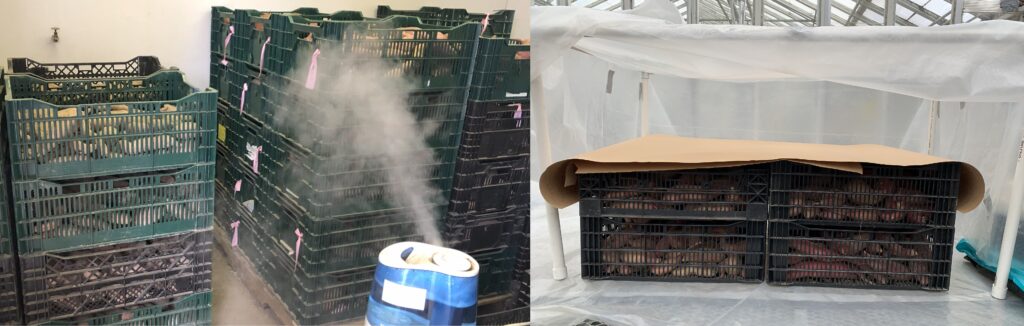
During curing, maintain warm and humid conditions for 1 to 3 weeks. Ideal conditions for curing are 80–90°F and 80–90% relative humidity for 1 week. Sweetpotatoes can be cured in a small room with a space heater and humidifier (Figure 1). However, curing can be done successfully at lower temperatures and will just take longer, 2 to 3 weeks, for example. Heat can be maintained with a built-in room heater, a space heater, or by placing roots in a greenhouse or a naturally warm area of your home. Humidity can be maintained with a small humidifier or trays of water. When a dedicated curing room is not available, use loosely draped plastic or construct a plastic tent to maintain humidity. A small curing chamber can be constructed using a PVC pipe frame covered with clear plastic with a humidifier placed inside (Figure 1).
If curing sweetpotatoes in an unheated greenhouse, use a tent, a space heater, or heat mats to ensure an adequate temperature is maintained overnight (Figure 2). Ventilation is needed to ensure moisture does not accumulate on root surfaces as this will lead to mold and rotting. For a small number of roots, place kraft paper on top of storage crates to absorb moisture if needed.
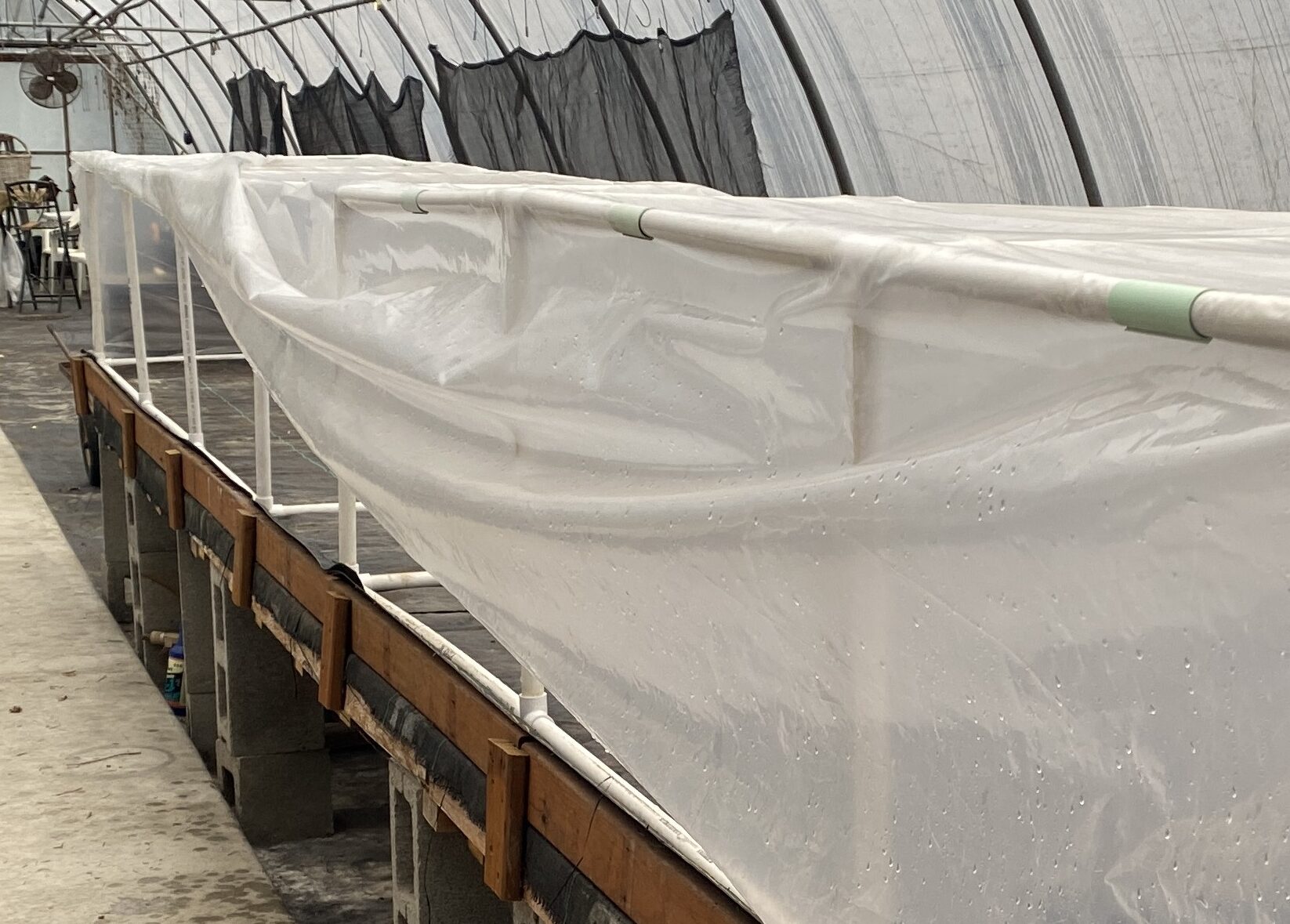
Closely monitor the heating element in the curing chamber or room to ensure the space is heated evenly and sweetpotatoes, especially those closest to the heater, are not overheated. Sweetpotatoes will be damaged if placed too close to a heating element or if the curing chamber or room gets too hot. Sweetpotato curing conditions are like those used for winter squash, and some farmers in western Washington have had success curing the two crops together in a greenhouse or insulated room.
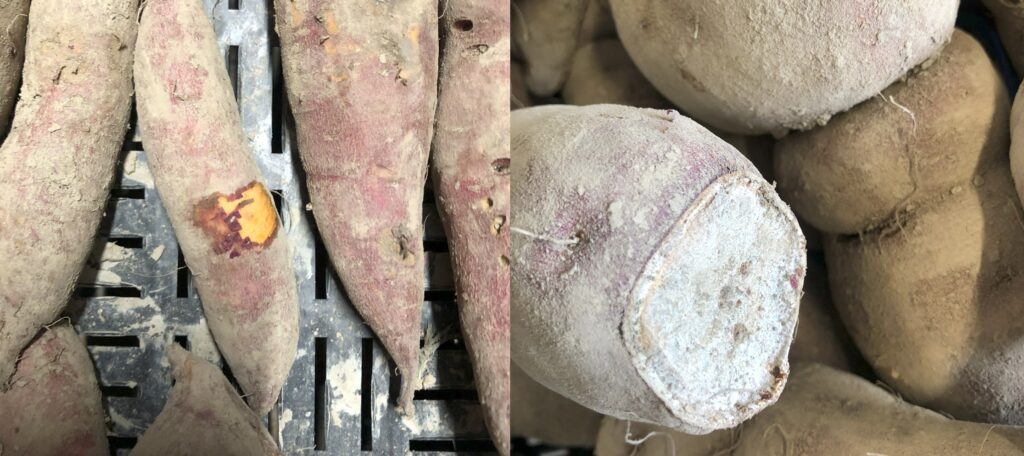
Properly cured sweetpotatoes will feel firm, do not skin easily, have healed-over wounds, and taste sweet (Figure 3).
Brix Measurements
Brix measures the amount of total soluble solids in a liquid, which are generally sugars for fruits and vegetables (Figure 4). These measurements provide a quick and easy method to quantify sweetness. Usually, sugar levels increase right after harvest and plateaus during curing (Table 1). See our standard operating procedure for measuring Brix.
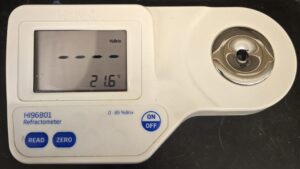
Table 1. Brix measurements of Bayou Belle, Cascade, and Covington before and after curing. Data from roots grown and cured at WSU NWREC in Mount Vernon, WA in 2024.
| Variety | Before Curing | After Curing |
|---|---|---|
| Bayou Belle | 6.6 | 9.1 |
| Cascade | 5.6 | 8.2 |
| Covington | 7.1 | 9.4 |
Storage
After curing is complete, store sweetpotatoes at 55–60°F, with 80–90% relative humidity. Storage can be done in the same room used for curing, with the heater turned to low or off. Below 50°F, chilling injury occurs, while sprouting occurs above 60°F. Exposure to hot, dry conditions during storage can increase moisture loss and may cause pithiness (dry, fibrous flesh, sometimes with visible air spaces) in some varieties (Woolfe 1992). Properly cured sweetpotatoes can be stored for 6 to 12 months or more. At home, wrap cured sweetpotatoes in newspaper or a paper bag and store in a cool closet or unheated storage room or garage.
References
Woolfe J. 1992. Sweet potato: An untapped food resource. Cambridge University Press, Cambridge, Great Britain.

The information in this publication is based upon work that is supported by the U.S. Department of Agriculture, National Institute of Food and Agriculture, under award number 2022-38640-37490 through the Western Sustainable Agriculture Research and Education Program under project number WPDP25-003, and Hatch Project WNP0010 Accession 7005372. Any opinions, findings, conclusions, or recommendations expressed in this publication are those of the author(s) and are not meant to endorse any businesses or detract from any not listed.