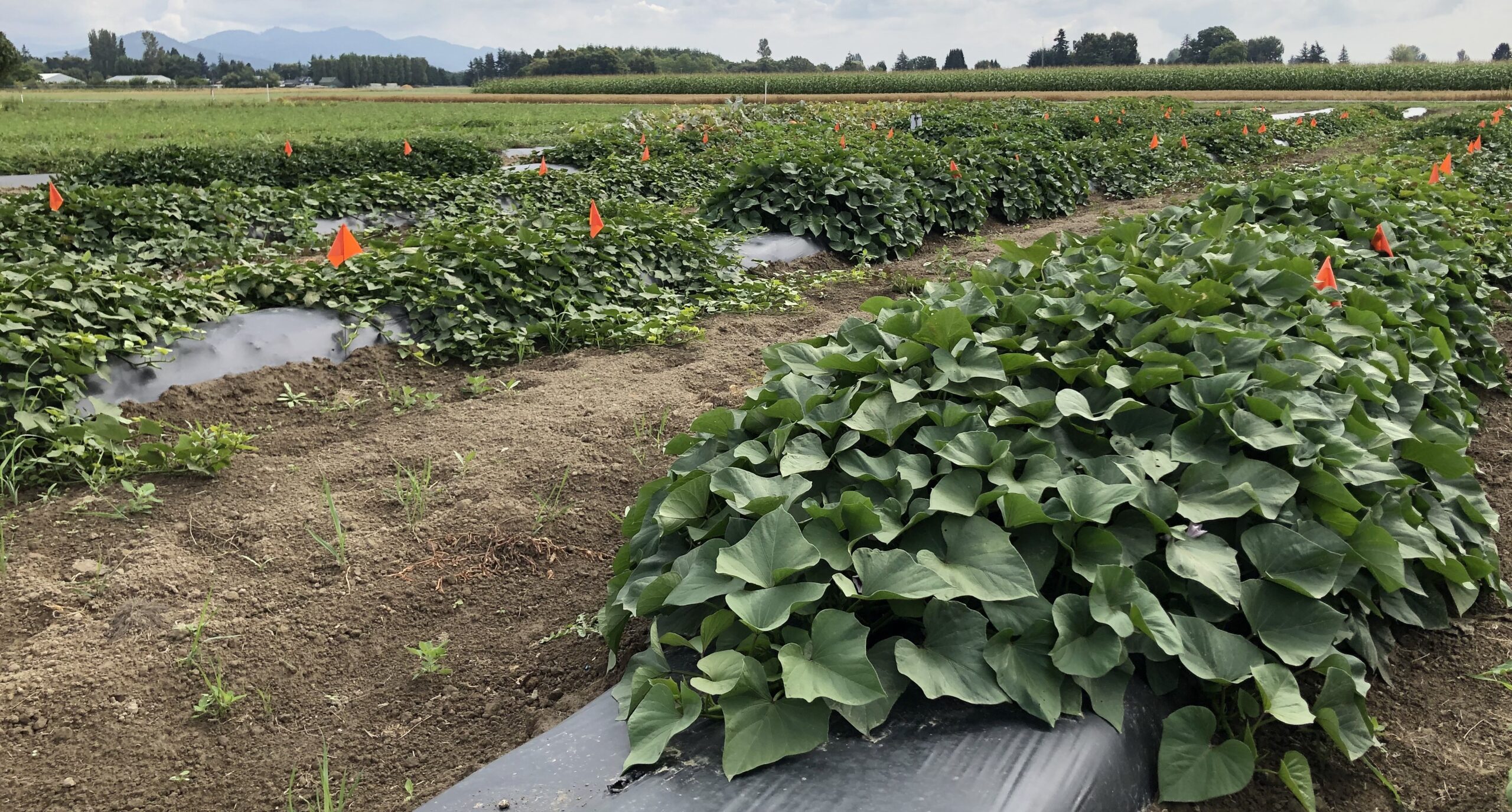
Growing Sweetpotatoes in Western Washington
Sweetpotato Slip Production
Authors: Laura Schulz1, Laurel Moulton2, Samantha Grieger2, Jordan White1, Jessica Weaver1, Srijana Shrestha3, Carol Miles1
Affiliation: Washington State University, 1Northwestern Washington Research and Extension Center, Mount Vernon; 2Extension; 3Oregon State University Extension
https://vegetables.wsu.edu/sweetpotato/
January 2026
Introduction
Sweetpotatoes (Ipomoea batatas) are planted using slips, which are vine cuttings about 6 to 12 inches long with 5 to 8 nodes, taken from sprouted sweetpotato roots (Figure 1). Sweetpotato slips can be purchased from seed catalogs, but producing your own slips can result in healthier slips.
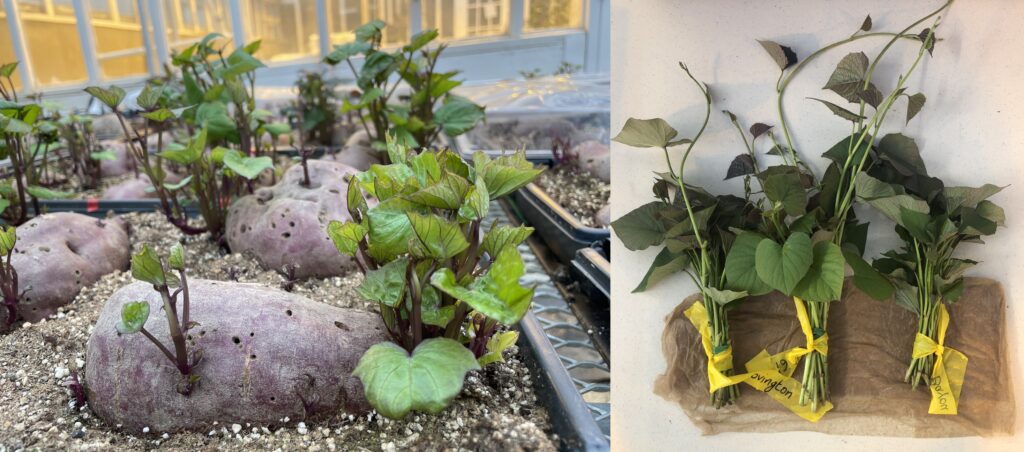
Slip production is relatively easy and can be done on a small or large scale. Growers can save sweetpotato roots after harvest for slip production the following year or purchase roots from certified producers to ensure disease-free and high-quality planting stock. Patented sweetpotato varieties (see Table 1 in Growing Sweetpotatoes in Western Washington: Varieties) should not be propagated on the farm.
Micropropagation & Viruses
Sweetpotatoes are propagated asexually using field-grown roots to produce slips, and viruses can build up with each generation. Viruses can reduce yield and root quality – for more information, see Growing Sweetpotatoes in Western Washington: Pests and Diseases. Virus-free, “clean” sweetpotato planting material is available through tissue culture or micropropagated plantlets. The apical meristem, which is the only part of the plant free from viruses, is carefully removed under a microscope, transferred to a growing media under sterile conditions, and grown to the plantlet stage.
Sweetpotato slip producers typically purchase these plantlets and propagate them by cuttings in a greenhouse. Those cuttings are then transferred to the field to produce “seed roots” and are propagated for one or two generations. Slips are harvested from these seed roots and are labeled G1 (generation 1), G2 (generation 2), and so on, based on the number of years they have been propagated in the field since micropropagation.
Micropropagated slips are expensive and growers typically choose G1 or G2 slips to balance cost and virus buildup. If slip suppliers do not list what generation their slips are, growers are encouraged to call and ask. Growers producing their own slips should replenish their seed stock with micropropagated or G1 material every 3-5 years, or when loss of vigor occurs. Currently, the only two sources in the U.S. of virus-free micropropagated sweetpotato plantlets are North Carolina State University Sweetpotato Breeding Program and the University of California-Davis Foundation Plant Services. For information on how to acclimate tissue culture plantlets to field conditions, see our fact sheet Acclimatization of Tissue Culture Plants.
Loosely cover the propagation tray with a clear plastic dome and water lightly when needed to maintain humidity without causing condensation (Figure 2). Be careful not to overwater especially before roots have started sprouting as this can lead to rotting. Only water trays when potting media is dry. Roots will begin to sprout after 2–3 weeks, though some late maturing varieties may take 4–5 weeks or more. Remove plastic domes after sprouts begin pushing up against them. If potting mix doesn’t contain fertilizer, a low concentration fertilizer can be added after slips begin to sprout if needed. Figure 2 provides an overview of sweetpotato slip production.
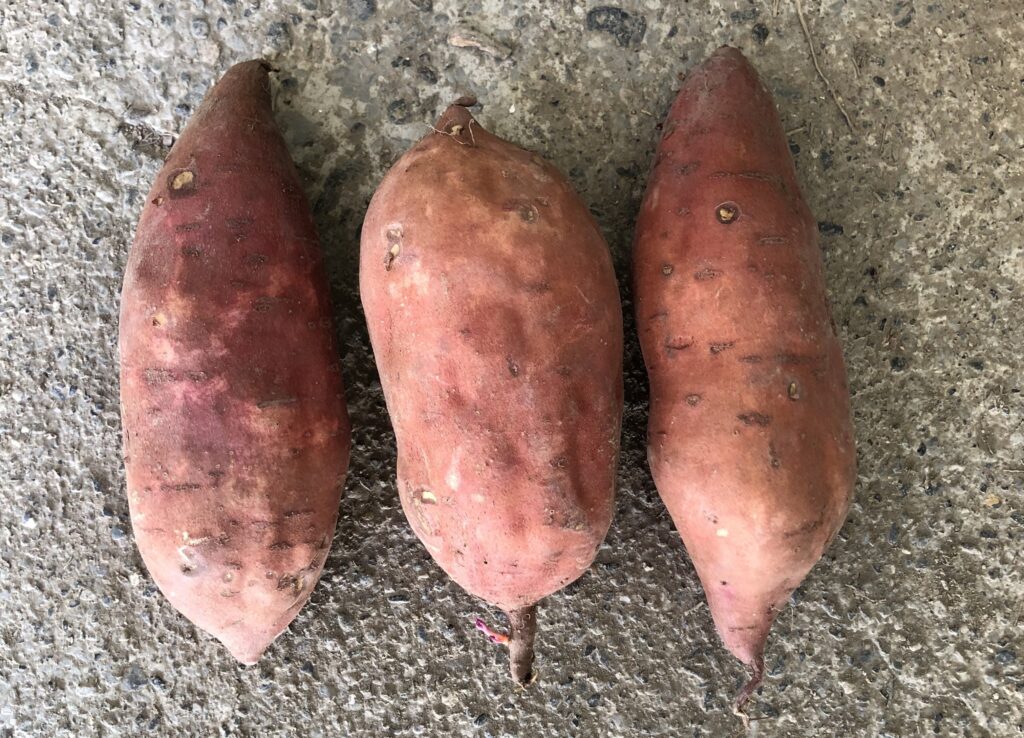
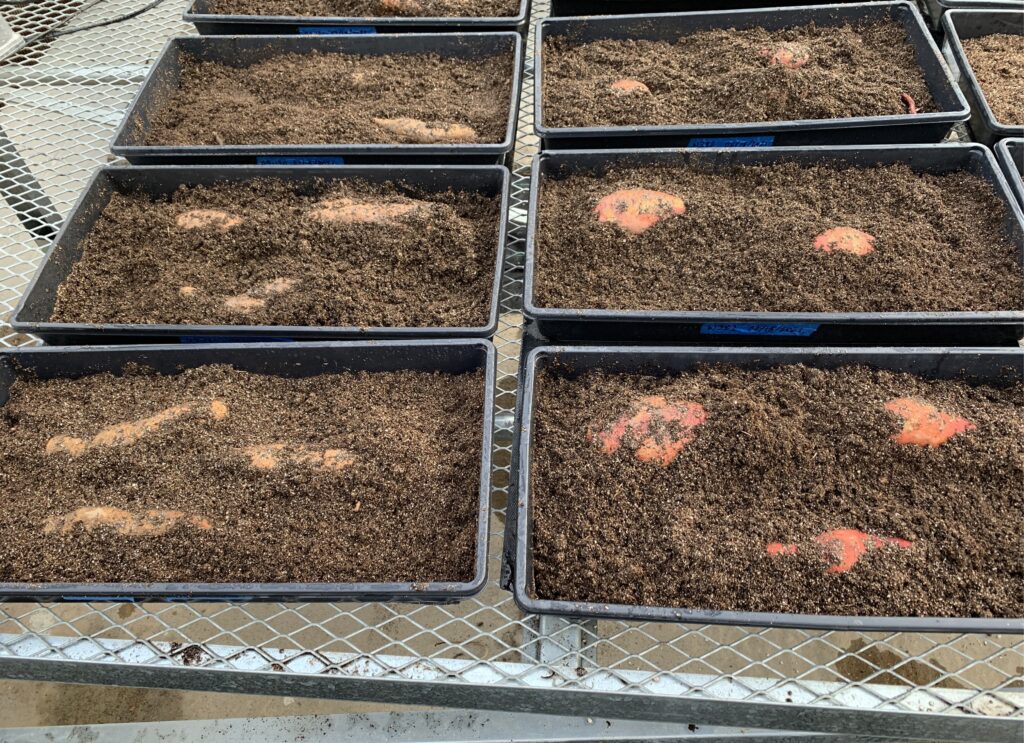
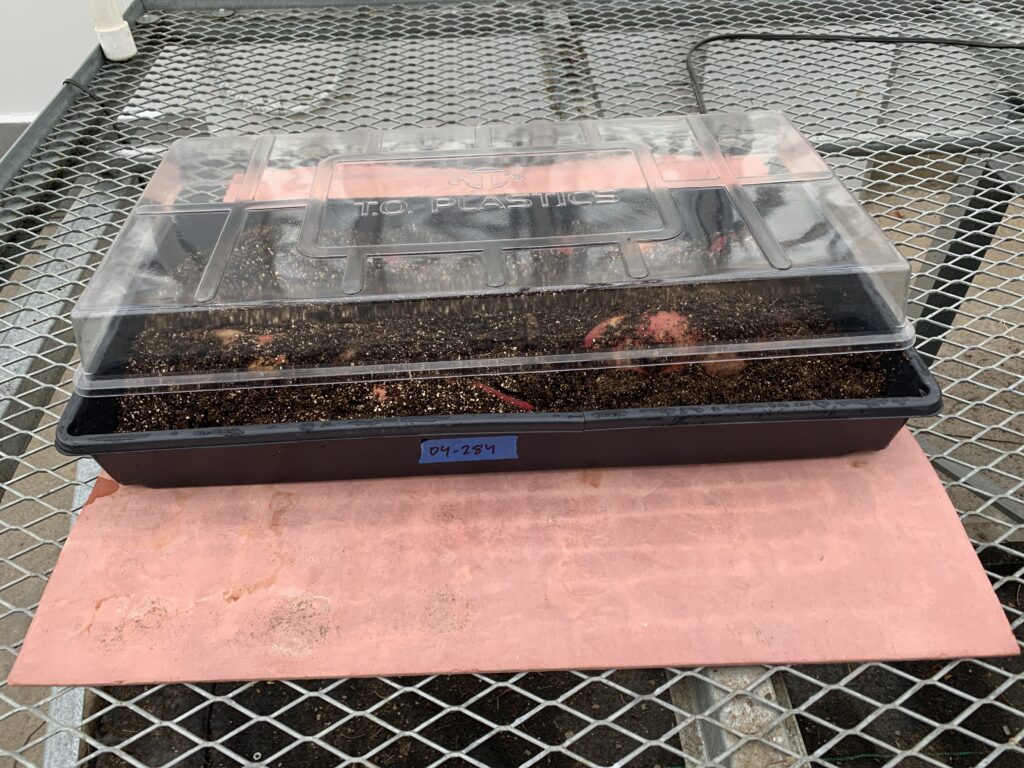
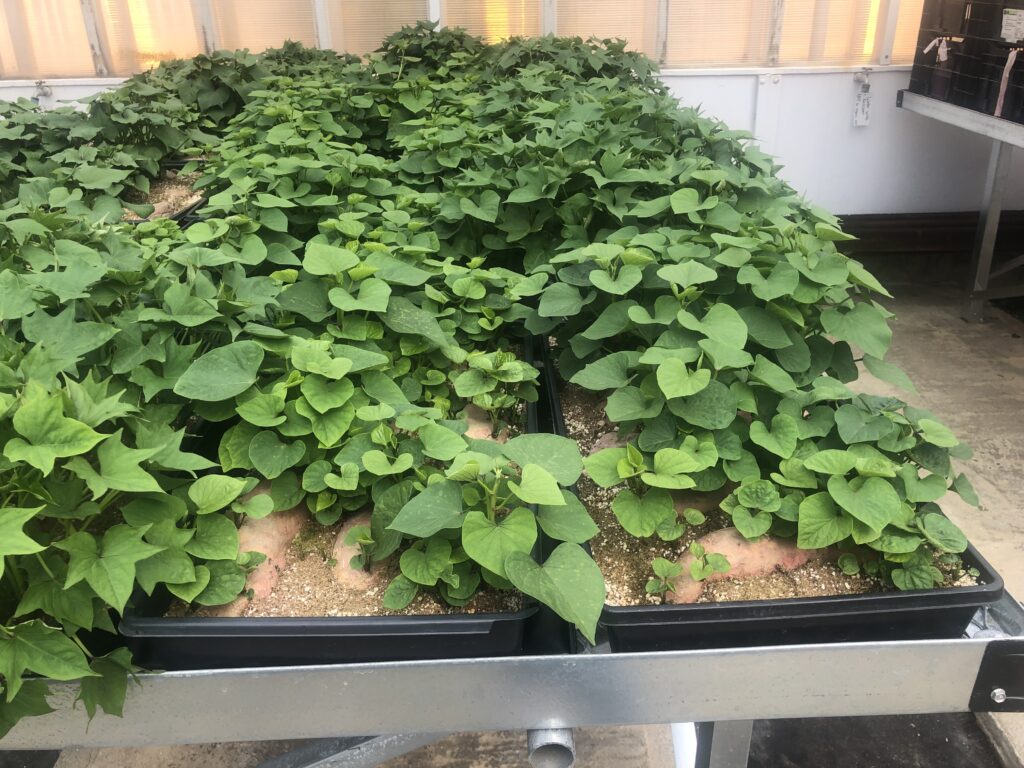
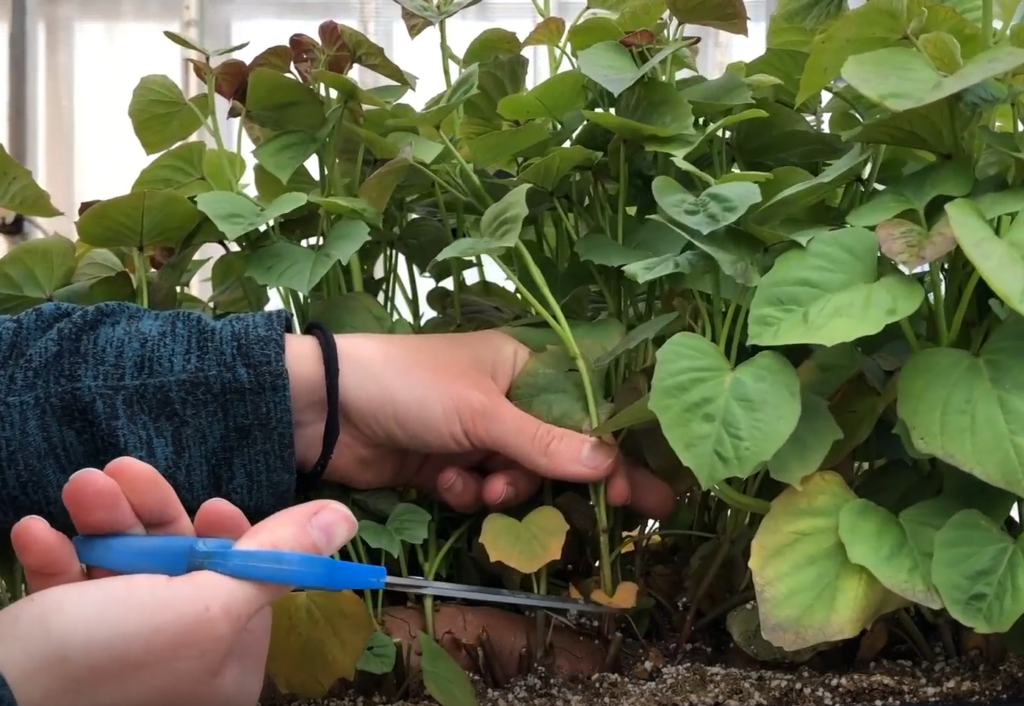
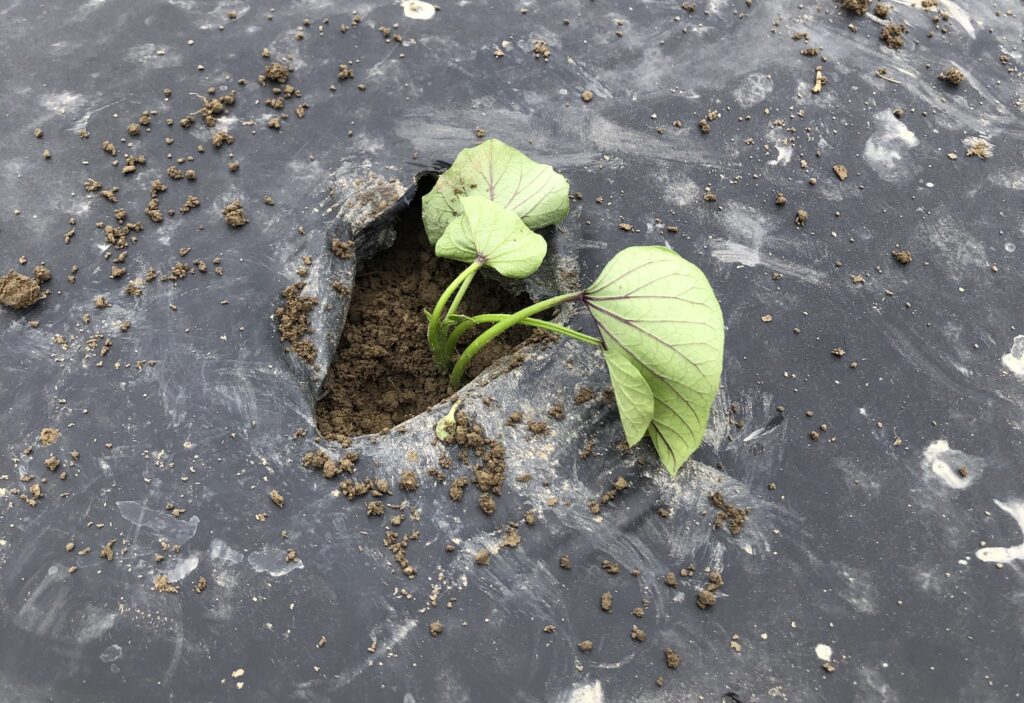
Figure 2. Overview of sweetpotato slip production.
Cutting Slips
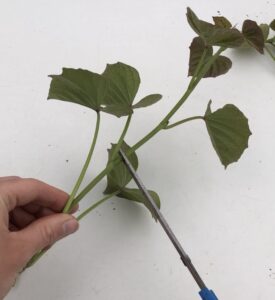
Cut slips when they are 6–12 inches long and have 5–8 leaves. Cut slips ½ to 1 inch above the root or soil to prevent transmission of soilborne disease (Figure 2). Divide longer vines into multiple slips with 5–8 leaves each (Figure 3).
Do not strip leaves off the lower nodes of the slips before planting. At WSU NWREC in 2024, sweetpotato root yield was 1.9 times greater when all leaves remained on the slips at planting than when leaves were stripped from the lower nodes.
Water Edema
Overwatering can lead to several issues including water edema which is caused by the roots taking up more water than the leaves lose through transpiration. Symptoms include white crust or powder, indentions, or blisters as the excess water bursts the plant cells. There are two approaches to treating sweetpotatoes for water edema. First, increase leaf transpiration by lowering the humidity – this can be done by removing the clear plastic domes, increasing air circulation by spacing out trays or using a fan, or increasing the ambient temperature. Second, decrease the water intake by ensuring proper drainage in the plastic flats or reducing watering frequency.
Slip Yield
One sweetpotato storage root can produce about 7 to 10 slips depending upon the variety and time allowed for growth. Under optimal slip production conditions, slips are produced in 6 to 8 weeks, though there is some variation by variety (Table 1). In general, early maturing varieties produce more slips faster, late maturing varieties produce fewer slips more slowly, and mid-maturing varieties are in between. If the temperature for slip production is less than 80–85°F, then 8 to 10 weeks or more may be needed for slip production, even for early maturity varieties.
Table 1. Time required to produce slips, average number of slips produced per root, and percentage of roots that did not produce any slips in a heated greenhouse (set at 80°F) with heat mats in Mount Vernon, WA in 2024 and 2025.
| Variety | Weeks for Slip Production | Average Number of Slips per Root | Roots that Produced Zero Slips (%) |
|---|---|---|---|
| Bayou Belle | 7 | 8 | 30 |
| Beauregard | 7 | 7 | 13 |
| Cascade | 6 | 14 | 5 |
| Covington | 8 | 7 | 0 |
| Monaco | 8 | 4 / 8a | 55 |
| Orleans | 7 | 7 | 20 |
Holding & Planting Slips
Slips can be planted immediately. Holding slips for 1–4 days in a cool (57–64°F) and shady location can alter hormone levels within the slip and initiate root development, which may increase slip survival and root yield (Hammett 1983; Nakatani et al. 1987). If holding slips prior to planting, place them in stackable, ventilated containers such as plastic bulb crates for storage. Do not tightly pack stored slips or soak them as this can initiate rot. Do not refrigerate slips (Hammett 1985).
Node Cuttings to Produce More Slips
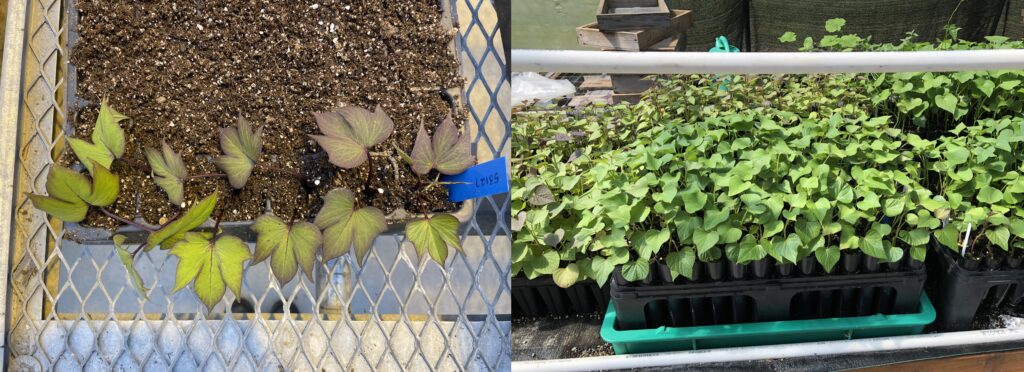
Many more slips per root can be obtained by starting the slip growing process earlier and cutting slips and rooting them in flats or pots in the greenhouse. Node cuttings and tip cuttings can be used to increase slip production. Node cuttings are produced by cutting a vine into many short segments with 1 to 2 nodes each (Figure 4). Tip cuttings are produced by cutting 1 to 2 nodes from the tip of a vine and these tend to grow quickly. All cuttings can be rooted in a 72-cell tray or 4-inch pots. The original sweetpotato roots will continue to produce more slips, and the rooted slips will grow into vines that can then be cut into multiple slips.
References
Hammett, HL. 1983. Effects of holding sweet potato cuttings. Louisiana Agriculture. 26(3):6-7.
Hammett LK. 1985. Refrigerated storage influence on sweet potato transplant viability and root yield. HortScience. 20:198-200. https://doi.org/10.21273/HORTSCI.20.2.198.
Nakatani M, Oyanagi A, Watanabe Y. 1987. Holding of cut-sprouts in sweet potato (Ipomoea batatas Lam.). Japan. Jour. Crop Sci 56(2):244-251. https://doi.org/10.1626/jcs.56.238.

The information in this publication is based upon work that is supported by the U.S. Department of Agriculture, National Institute of Food and Agriculture, under award number 2022-38640-37490 through the Western Sustainable Agriculture Research and Education Program under project number WPDP25-003, and Hatch Project WNP0010 Accession 7005372. Any opinions, findings, conclusions, or recommendations expressed in this publication are those of the author(s) and are not meant to endorse any businesses or detract from any not listed.